
Post-Quantum Cryptography Protects Trust.Execution Governance Protects Decisions.


Secure communications are essential. Authorized execution is indispensable.
The Next Generation of Digital Infrastructure
The United States has formally accelerated its transition toward Post-Quantum Cryptography through a new Executive Order focused on protecting Federal systems, critical infrastructure, and the digital economy from future cryptographic threats posed by quantum computing.
This transition represents one of the most significant cybersecurity modernization efforts in decades.
It recognizes a reality long anticipated by the cybersecurity community:
Today's public-key cryptography will not provide adequate protection indefinitely against sufficiently capable quantum computers.
Migration has become a national priority.
Yet while cryptography secures communications, autonomous systems introduce another infrastructure challenge.
Who authorizes execution?
Security Is No Longer Only About Encryption
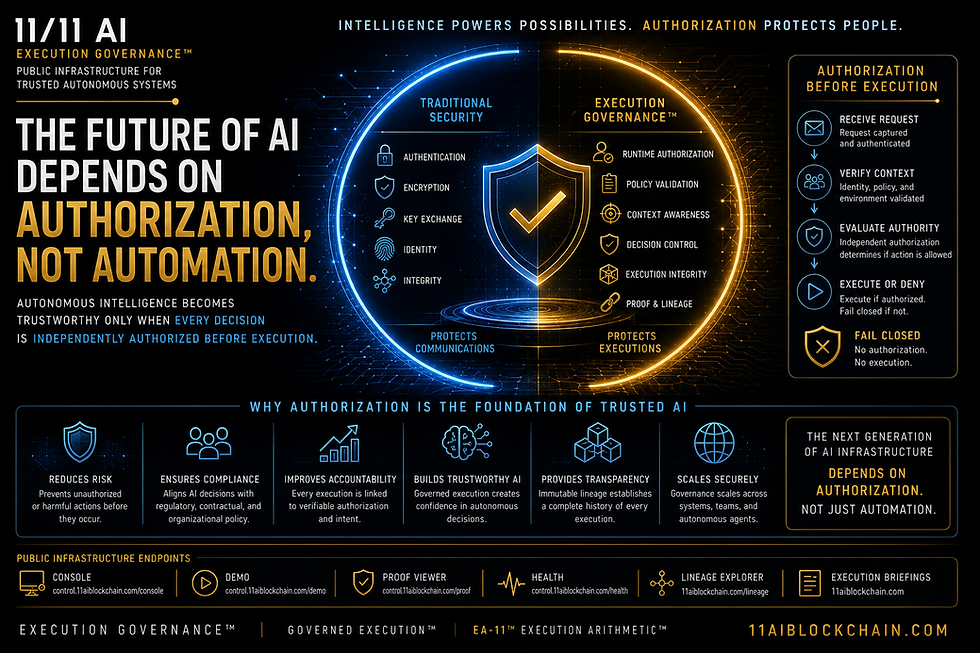
Traditional cybersecurity focuses on protecting information.
Encryption.
Authentication.
Identity.
Digital signatures.
Key exchange.
These technologies establish trust between systems.
Artificial Intelligence introduces trust between decisions.
A cryptographically authentic request may still produce an operationally unacceptable action.
Execution must therefore become independently governed.
Two Independent Infrastructure Layers
Future autonomous infrastructure consists of complementary security domains.
Layer One
Post-Quantum Cryptography
Purpose:
• Protect identities
• Secure communications
• Preserve confidentiality
• Authenticate participants
• Protect digital signatures
Layer Two
Execution Governance
Purpose:
• Verify authorization
• Validate policy
• Enforce runtime controls
• Produce immutable proof
• Preserve execution lineage
These layers solve different problems.
Together they strengthen trustworthy autonomous infrastructure.
Why Execution Governance Matters
As AI systems move into financial networks, defense platforms, healthcare, industrial automation, and critical infrastructure, organizations increasingly require assurance that execution itself complied with governance policy before an action occurred.
This represents a shift from observing behavior after execution toward validating authorization before execution.
Execution Governance introduces an independent authorization boundary designed to support this objective.
The Future Architecture
Future AI systems will require more than secure communications.
They will require secure decisions.
Cryptography establishes trust between participants.
Execution Governance establishes trust in autonomous behavior.
Together they create stronger foundations for resilient digital infrastructure.
Closing Statement
Post-Quantum Cryptography protects trust.
Execution Governance protects decisions.
The future of trusted autonomous infrastructure depends on both.
Encryption protects communications. Execution Governance protects authorization. Trusted AI requires both.
Execution Governance™ • Governed Execution™ • EA-11™ Execution Arithmetic™
Patent Pending
Public Infrastructure
Latest Research and Executive Briefings
This page serves as the authoritative publication archive for 11/11 AI research, execution governance doctrine, technical analyses, and infrastructure updates.
Latest Publications
The Quantum Transition Requires More Than Cryptography
Post-Quantum Cryptography Protects Trust. Execution Governance Protects Decisions.


Comments