
Quantum-Safe Infrastructure Requires Governed Execution


The next generation of trusted infrastructure must secure both communications and autonomous decisions.
The Quantum Era Is Changing Infrastructure
The transition to Post-Quantum Cryptography represents one of the most significant infrastructure upgrades in modern computing.
Governments, financial institutions, healthcare organizations, defense agencies, and operators of critical infrastructure are preparing for a future where quantum-capable adversaries may challenge today's public-key cryptography.
The objective is clear.
Protect communications.
Protect identities.
Protect digital trust.
These investments strengthen the foundations of secure computing.
Yet secure communications alone do not determine whether an autonomous system should execute an action.
That requires governance.
Security Does Not Equal Authorization
A request may be:
• Authenticated
• Encrypted
• Digitally signed
• Quantum resistant
…and still produce an action that violates organizational policy.
Artificial intelligence introduces operational decisions that extend beyond traditional cybersecurity.
Trusting a communication channel is fundamentally different from trusting autonomous behavior.
Execution Governance addresses that distinction.
Authorization Before Runtime
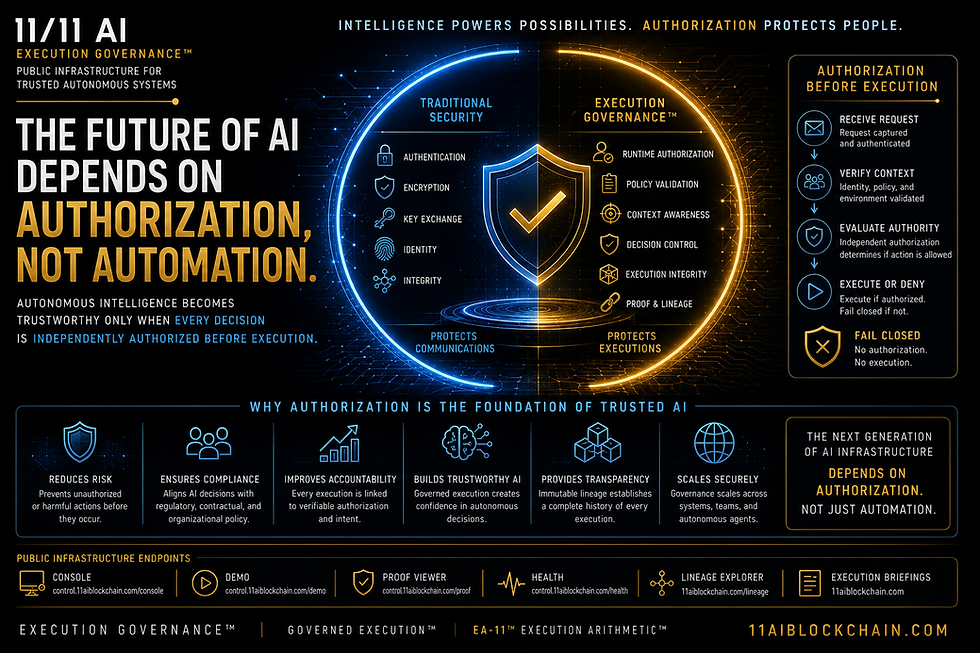
Execution Governance establishes an independent authorization layer before execution begins.
Instead of relying solely on logging or post-event analysis, execution requests are evaluated before autonomous actions occur.
Typical governance validation may include:
Policy verification
Identity validation
Environmental context
Organizational controls
Independent authorization
Immutable execution receipts
Cryptographic lineage
If required conditions are not satisfied, execution does not proceed.
This fail-closed approach reduces operational risk while improving accountability.
Complementary Infrastructure
Future autonomous systems require multiple layers of trust.
Quantum-Safe Cryptography
Protects:
Communications
Encryption
Authentication
Digital Signatures
Key Exchange
Execution Governance
Protects:
Runtime Authorization
Policy Compliance
Decision Validation
Execution Proof
Governance Lineage
Each layer addresses a different aspect of trust.
Neither replaces the other.
Together they contribute to more resilient autonomous infrastructure.
Building Trustworthy AI
Artificial intelligence is becoming part of systems that support financial services, healthcare, manufacturing, transportation, energy, and national security.
As these systems assume greater operational responsibility, organizations increasingly need confidence not only in secure communications but also in authorized execution.
Execution Governance provides an architectural approach for evaluating whether autonomous actions satisfy governance requirements before they occur.
This complements broader cybersecurity modernization efforts, including the transition to post-quantum cryptography.
Looking Forward
The move toward quantum-resistant cryptography marks an important milestone for digital infrastructure.
The next phase is ensuring that autonomous systems execute only when policy, governance, and authorization requirements have been satisfied.
Together, cryptographic security and execution governance represent complementary layers of trust for the next generation of AI-enabled infrastructure.
Quantum-safe communications establish trust between systems. Execution Governance establishes trust in autonomous decisions.
Key Takeaways
Quantum-safe cryptography strengthens communications.
Execution Governance strengthens autonomous decision making.
Future infrastructure requires both secure communications and authorized execution.
Trustworthy AI depends on governance before runtime, not only auditing after execution.
Execution Governance™ • Governed Execution™ • EA-11™ Execution Arithmetic™
Patent Pending
Public Infrastructure


Comments