
The Quantum Transition Requires More Than Cryptography


Protecting communications is only half of securing autonomous systems. The future requires authorization before execution.
The White House Has Accelerated America's Quantum Transition
The United States has entered a new phase of cybersecurity.
With the issuance of the White House Executive Order, "Securing the Nation Against Advanced Cryptographic Attacks," the Federal Government has accelerated the transition toward Post-Quantum Cryptography (PQC). The order directs agencies to adopt quantum-resistant cryptographic standards while strengthening the nation's resilience against future cryptographic threats.
This represents an important milestone in the evolution of digital infrastructure.
For decades, cybersecurity investments focused primarily on securing communications, identities, digital signatures, and key exchange. Post-Quantum Cryptography extends those protections into a future where large-scale quantum computers could undermine today's public-key cryptography.
That transition is necessary.
It is also only part of the solution.
Cryptography Answers One Question
Modern cryptography establishes trust between communicating systems.
It answers questions such as:
Is this message authentic?
Was it modified?
Who signed it?
Can the sender be trusted?
Can the communication remain confidential?
These are foundational security requirements.
The Executive Order reinforces their importance by accelerating the migration toward NIST-standardized quantum-resistant algorithms across Federal systems and encouraging broader adoption throughout critical infrastructure.
Autonomous Systems Introduce a Different Question
Artificial Intelligence changes the security model.
A perfectly authenticated request can still perform an unauthorized action.
A quantum-safe signature does not determine whether an AI model should execute.
An autonomous system may receive instructions from trusted identities while still making decisions that violate organizational policy, regulatory requirements, operational constraints, or safety boundaries.
This introduces a fundamentally different governance problem.
Rather than asking whether communication is secure, organizations must determine whether execution itself is authorized.
Execution Governance Addresses Runtime Authorization
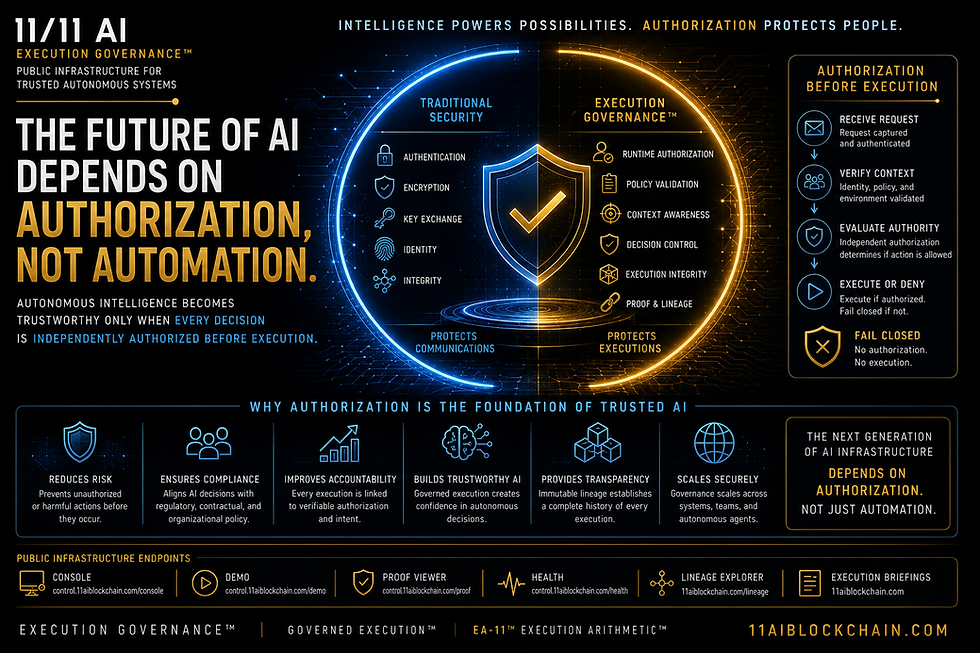
Execution Governance operates independently from cryptography.
Instead of protecting communication channels, it governs execution.
Before any autonomous action occurs, the system evaluates whether execution satisfies defined governance requirements.
These requirements may include:
Policy validation
Identity verification
Context verification
Runtime authorization
Independent governance approval
Immutable authorization receipts
Execution lineage
Only after successful verification does execution proceed.
If authorization cannot be established, execution terminates safely.
Fail Closed.
Security and Governance Are Complementary
Post-Quantum Cryptography and Execution Governance solve different problems.
Post-Quantum Cryptography protects trust between systems.
Execution Governance protects trust in autonomous behavior.
Together they establish two complementary infrastructure layers:
Cryptographic Infrastructure
Identity
Encryption
Authentication
Digital signatures
Key exchange
Execution Infrastructure
Authorization
Runtime enforcement
Policy compliance
Governance validation
Immutable execution proof
Decision lineage
Neither replaces the other.
Both are required for trustworthy autonomous systems.
The Infrastructure Shift
As AI expands into finance, healthcare, defense, industrial automation, and critical infrastructure, execution becomes as significant as communication.
Organizations will increasingly need to demonstrate not only that communications were secure but also that autonomous decisions complied with governance policies before execution.
This distinction becomes especially important where safety, regulatory compliance, or national security objectives are involved.
Looking Forward
The White House Executive Order establishes a clear national direction for strengthening cryptographic resilience.
As quantum-resistant cryptography becomes foundational infrastructure, attention will increasingly turn toward how autonomous systems are authorized, governed, and verified during execution.
Execution Governance addresses that emerging challenge by introducing authorization before runtime rather than relying solely on auditing after execution.
Together, these complementary disciplines represent different layers of trust for increasingly autonomous digital infrastructure.
Conclusion
Post-Quantum Cryptography protects identities.
Execution Governance protects decisions.
One secures communications.
The other secures execution.
Future autonomous infrastructure will increasingly depend on both.
Post-Quantum Cryptography secures the keys. Execution Governance secures the decisions. Trusted autonomous systems require both.
Public Infrastructure
Execution Governance™ • Governed Execution™ • EA-11™ Execution Arithmetic™
Patent Pending


Comments