
Runtime Governance Will Define Trusted AI Infrastructure
- 11/11 AI

- May 10
- 2 min read

Historically, infrastructure trusted execution once systems started running.
That assumption no longer scales.
AI systems increasingly operate:
autonomously
continuously
across distributed environments
at machine speed
with expanding operational authority
This changes the foundation of infrastructure trust.
Trust can no longer exist only:before runtime.
Trust must persist:during runtime itself.
This creates a new infrastructure requirement:
runtime governance.
SECTION 1 — THE RUNTIME PROBLEM
Traditional infrastructure security focused heavily on:
perimeter defense
authentication
identity access
endpoint protection
observability systems
These systems primarily establish trust:before execution.
But AI infrastructure introduces continuous runtime risk.
Execution environments now evolve dynamically through:
autonomous decisions
agent coordination
workflow orchestration
infrastructure automation
distributed execution chains
machine-generated actions
Trust state can change during execution itself.
Infrastructure must continuously validate runtime trust.
SECTION 2 — EXECUTION WITHOUT RUNTIME GOVERNANCE
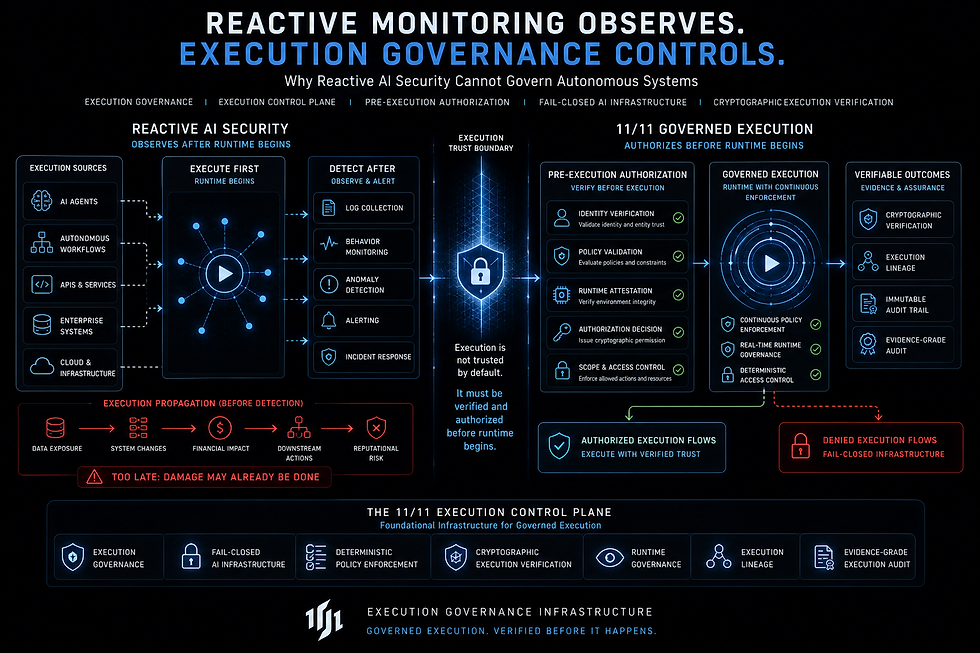
Without runtime governance, systems often rely on:implicit trust continuity.
Execution begins, and trust assumptions remain active indefinitely.
This creates operational gaps where:
policy drift occurs
authorization context changes
runtime state degrades
governance continuity breaks
execution authority becomes stale
trust assumptions diverge from runtime reality
AI infrastructure cannot safely scale under static trust assumptions.
SECTION 3 — WHAT RUNTIME GOVERNANCE MEANS
11/11 Runtime Governance Layer introduces:continuous runtime trust enforcement.
Governance no longer operates as:a one-time authorization event.
Instead, runtime trust becomes continuously validated during execution.
This includes:
policy continuity validation
authorization integrity checks
runtime environment attestation
cryptographic verification
governance state enforcement
deterministic execution validation
Execution trust becomes:continuously enforceable.
SECTION 4 — RUNTIME TRUST ARCHITECTURE
11/11 Runtime Trust Architecture embeds governance directly into runtime execution flow.
Execution becomes dependent on:ongoing trust continuity.
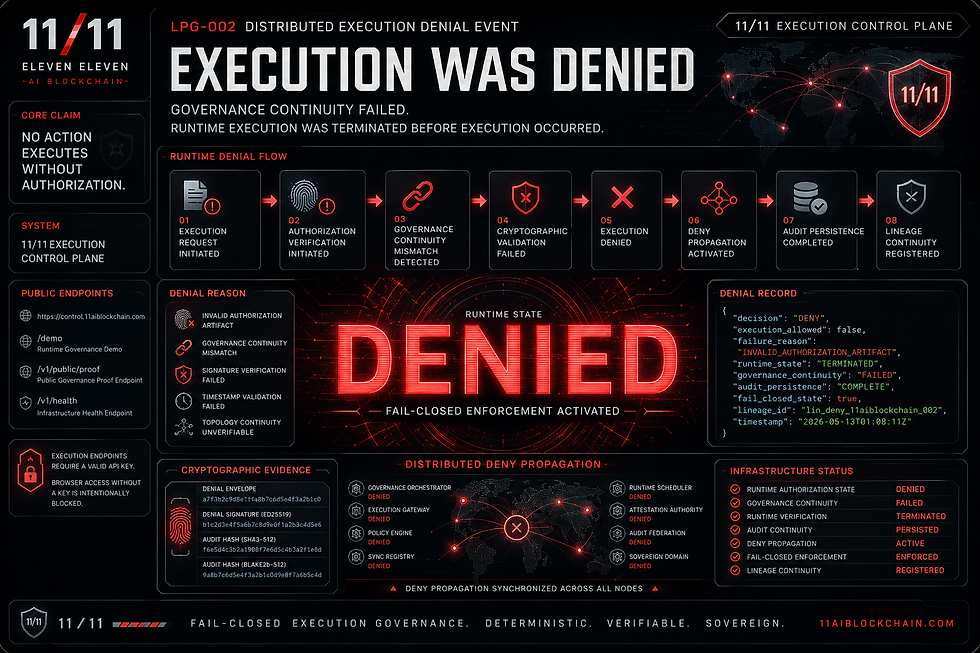
If runtime governance becomes invalid:execution can be denied, paused, or terminated.
This creates:fail-closed runtime infrastructure.
Trust continuity becomes mandatory for execution continuity.
SECTION 5 — DETERMINISTIC RUNTIME ENFORCEMENT
Most systems today operate through:reactive monitoring.
11/11 Runtime Governance Layer introduces:deterministic runtime enforcement.
This means:execution proceeds only while governance conditions remain valid.
Runtime enforcement continuously evaluates:
execution scope
policy alignment
authorization continuity
runtime integrity
cryptographic trust state
environment consistency
Governance becomes active operational infrastructure.
SECTION 6 — GOVERNANCE AS A CONTINUOUS SYSTEM
Runtime governance transforms infrastructure from:static trust
into:continuous trust validation.
This creates a fundamentally different operational model.
Execution authority becomes: dynamic, governed, and continuously enforceable.
The infrastructure itself actively determines:whether execution trust remains valid throughout runtime activity.
SECTION 7 — TRUSTED AI INFRASTRUCTURE
Trusted AI infrastructure requires more than: identity, monitoring, or observability.
It requires:continuous runtime governance.
This becomes foundational for:
enterprise AI systems
autonomous agents
financial AI infrastructure
defense systems
healthcare environments
regulated compute systems
Runtime governance becomes mandatory infrastructure logic.
SECTION 8 — THE FUTURE OF GOVERNED EXECUTION
11/11 Runtime Governance Layer establishes:runtime governance as a foundational infrastructure primitive.
This introduces:
deterministic runtime trust
fail-closed governance enforcement
cryptographic execution continuity
governed execution validation
runtime lineage continuity
evidence-grade runtime audit
Execution itself becomes:continuously governed infrastructure.
CLOSING
The future of AI infrastructure depends on:runtime governance.
Execution trust can no longer rely on static authorization assumptions.
Trust must become: continuous, verifiable, governed, and cryptographically enforceable during runtime itself.
Runtime governance will define trusted AI infrastructure.
11/11 is building the execution governance layer for AI infrastructure.

Comments