
PILLAR PAGE 11 Runtime Integrity Systems for Governed AI Infrastructure | 11/11 Execution Governance


Runtime Integrity Systems
The Shift From Monitoring to Enforcement
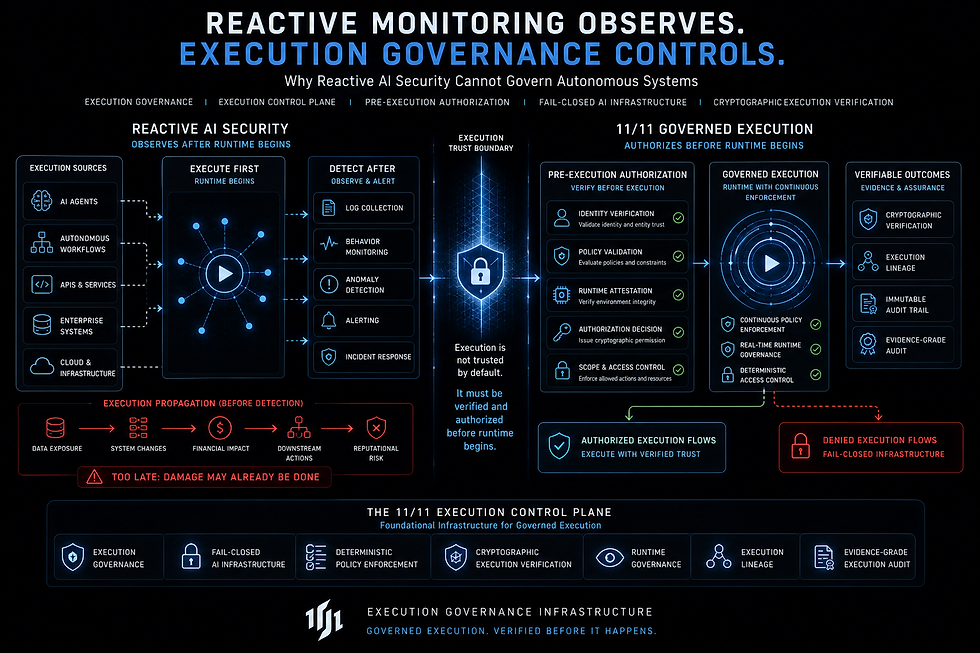
Traditional infrastructure monitors systems after execution has already occurred.
Execution governance infrastructure changes this model entirely.
Runtime integrity systems establish deterministic operational control before execution begins, during execution lifecycle enforcement, and throughout post-execution verification.
This transition fundamentally changes how AI infrastructure, autonomous systems, distributed runtimes, and sensitive execution environments operate.
Instead of:
execute first
analyze later
respond after compromise
governed infrastructure requires:
authorization before execution
deterministic runtime enforcement
cryptographic execution validation
immutable execution lineage
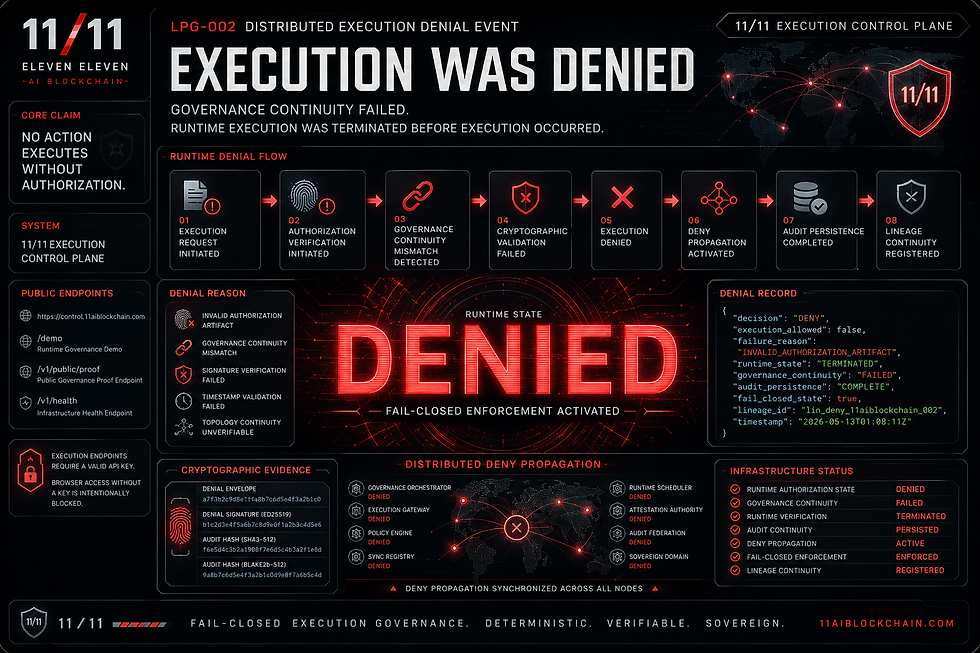
fail-closed denial behavior
This is the foundation of execution governance infrastructure.
What Is Runtime Integrity?
Runtime integrity refers to the ability of infrastructure systems to verify that execution behavior remains authorized, deterministic, policy-compliant, and cryptographically verifiable throughout the operational lifecycle.
A runtime integrity system validates:
who initiated execution
what was authorized
where execution is permitted
which policies apply
whether runtime state remains compliant
whether cryptographic authorization remains valid
whether lineage persistence is intact
Without runtime integrity enforcement, infrastructure becomes observational rather than authoritative.
Why Runtime Integrity Matters
Modern AI infrastructure increasingly operates autonomously.
Autonomous systems can:
trigger downstream execution
invoke external services
access sensitive environments
orchestrate infrastructure actions
modify runtime state
interact with critical systems
Traditional security architectures were not designed for continuously autonomous execution environments.
This creates a governance gap.
Runtime integrity systems close that gap through deterministic operational enforcement.
Core Components of Runtime Integrity Infrastructure
Execution Authorization Layer
Every execution request must first pass through an authorization system capable of validating:
identity
policy scope
environment trust
runtime constraints
execution permissions
temporal validity
cryptographic authorization artifacts
This prevents unauthorized execution from entering the runtime layer.
Related:
Governed Execution
Runtime Authorization
Execution Control Planes
Deterministic Enforcement Engine
A runtime integrity system must enforce decisions consistently.
Deterministic enforcement means:
identical conditions produce identical outcomes
policy evaluation remains stable
execution behavior is predictable
denial behavior is fail-closed
enforcement logic cannot silently degrade
This creates infrastructure-grade trust consistency.
Cryptographic Verification Systems
Execution governance infrastructure increasingly depends on cryptographic validation systems.
These systems verify:
authorization signatures
execution artifact integrity
policy authenticity
runtime attestation
immutable audit persistence
execution lineage continuity
Cryptographic verification transforms governance from trust-based to evidence-based infrastructure.
Fail-Closed Runtime Enforcement
Fail-open systems continue operating when governance layers fail.
Fail-closed infrastructure does the opposite.
If runtime authorization cannot be validated:
execution does not occur.
This principle is essential for:
defense systems
healthcare AI
financial infrastructure
sovereign AI systems
autonomous infrastructure
critical operational environments
Fail-closed runtime integrity establishes operational trust boundaries.
Runtime Integrity and Execution Lineage
Runtime integrity systems must persist immutable execution lineage.
Execution lineage provides:
authorization traceability
execution chain visibility
runtime dependency mapping
policy inheritance tracking
evidence-grade audit verification
Execution lineage allows organizations to reconstruct operational history with deterministic accuracy.
Related:
Execution Lineage Systems
Cryptographic Runtime Verification
Governance Audit Infrastructure
Distributed Runtime Integrity
Modern infrastructure operates across:
multi-cloud environments
Kubernetes clusters
edge systems
sovereign regions
hybrid infrastructure
autonomous orchestration layers
Runtime integrity systems must therefore function as distributed governance infrastructure.
This requires:
distributed policy synchronization
federated runtime trust
cryptographic coordination
deterministic cross-domain enforcement
globally consistent governance behavior
Execution governance infrastructure cannot depend on a single centralized runtime assumption.
Runtime Integrity in Autonomous AI Systems
As AI systems gain increasing operational autonomy, runtime integrity becomes mandatory infrastructure.
Autonomous execution environments require:
continuous policy validation
runtime trust verification
execution boundary enforcement
cryptographic governance validation
lineage-aware orchestration
deterministic denial behavior
This is especially important for:
autonomous infrastructure orchestration
AI-driven operations
defense AI systems
financial execution engines
industrial automation
regulated healthcare systems
Governance Control Planes and Runtime Integrity
Runtime integrity systems are enforced through governance control planes.
Governance control planes coordinate:
execution authorization
runtime policy enforcement
trust boundary management
cryptographic validation
lineage persistence
enforcement telemetry
infrastructure observability
This creates a structured execution governance architecture rather than isolated security tooling.
Public Governance Infrastructure
The 11/11 execution governance infrastructure demonstrates live governance concepts through public operational systems:
Runtime Governance Demo
Public Governance Console
Governance Proof Viewer
Infrastructure Health Dashboard
Execution Lineage Explorer
The Future of Runtime Integrity
Runtime integrity systems will increasingly become foundational infrastructure for governed AI and autonomous execution environments.
The next generation of infrastructure will require:
deterministic runtime authorization
cryptographic execution governance
distributed policy enforcement
immutable execution lineage
fail-closed operational semantics
governance-native orchestration
Execution governance infrastructure is evolving into a mandatory operational layer for mission-critical AI systems.
Runtime integrity systems are one of the foundational components enabling that transition.

Comments