
Runtime Trust Boundaries in Autonomous Infrastructure
- 11/11 AI

- May 25
- 3 min read

Modern infrastructure is increasingly transitioning from:human-supervised execution
to:machine-mediated operational autonomy.
This transition is redefining the architectural importance of runtime trust boundaries.
Historically, trust boundaries were treated primarily as:
network segmentation controls
identity enforcement zones
perimeter authorization layers
static infrastructure security domains
Autonomous infrastructure fundamentally changes this model.
In machine-speed operational systems, trust is no longer solely associated with:
users
sessions
networks
static identities
Trust must now extend directly into runtime execution itself.
This is the core architectural premise behind execution governance infrastructure.
Runtime trust boundaries establish deterministic governance constraints around:
autonomous execution
machine-to-machine actions
agentic decision pathways
orchestration systems
infrastructure automation
policy-bound operational execution
Without runtime trust boundaries, autonomous systems inherit a critical failure condition:
execution authority becomes probabilistic.
This creates operational exposure across:
defense systems
industrial automation
financial orchestration
healthcare infrastructure
logistics networks
critical infrastructure environments
cross-domain AI systems
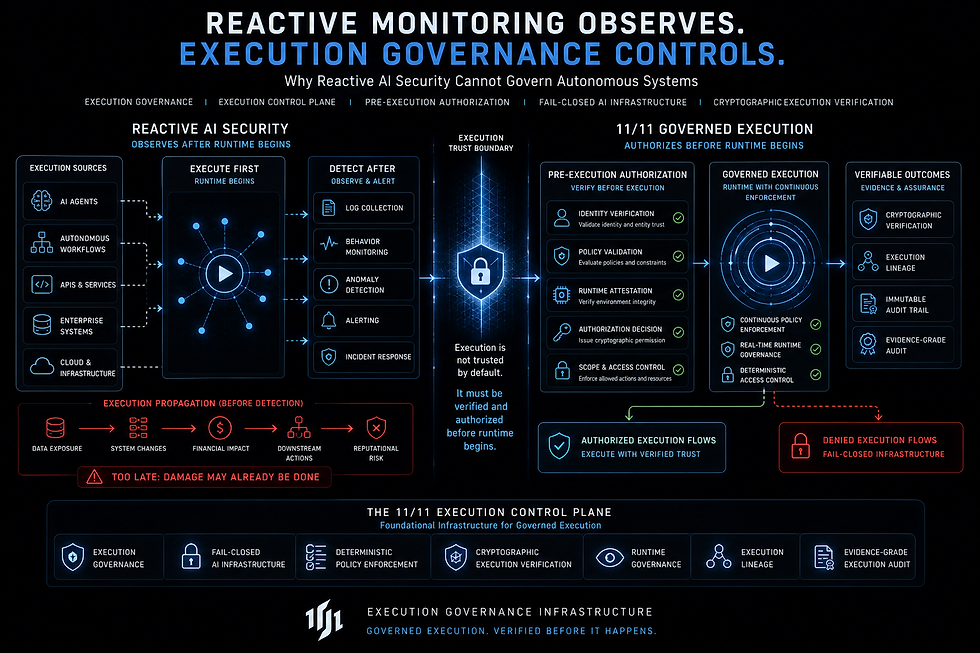
Traditional observability infrastructure cannot resolve this problem.
Telemetry may explain:what occurred.
But it does not deterministically prevent:unauthorized execution.
Execution Governance™ infrastructure introduces a different operational model.
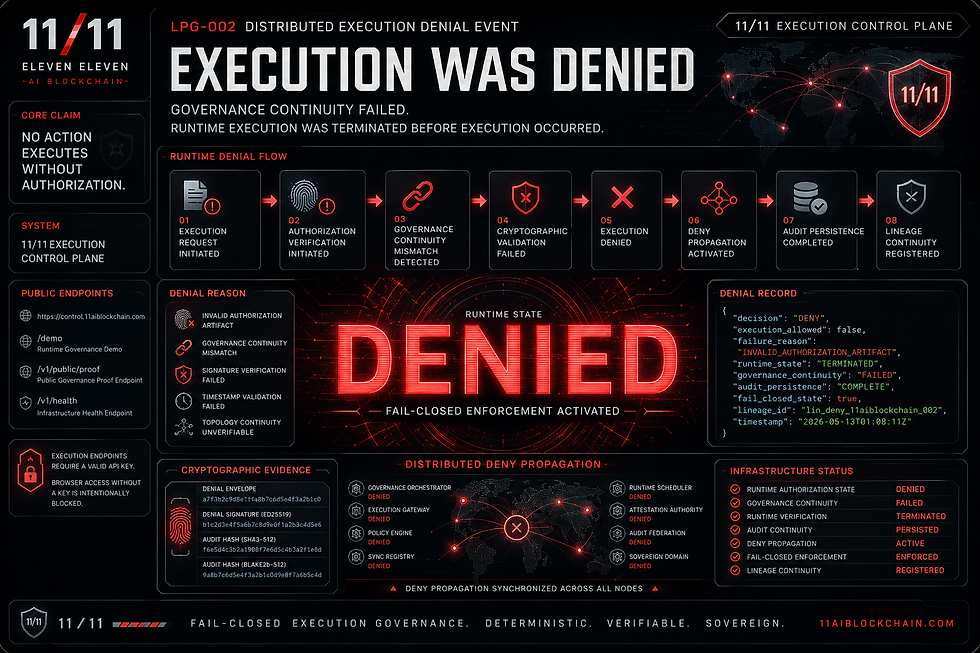
Under governed execution architecture:authorization is validated before runtime action occurs.
This transforms trust boundaries from passive observation zones into:active execution enforcement layers.
The distinction is operationally significant.
A runtime trust boundary operating under fail-closed governance semantics enforces:
pre-execution authorization validation
policy-bound runtime admission
cryptographic execution verification
deterministic authorization dependencies
execution lineage continuity
governance attestation persistence
authorization-bound orchestration
In this model:“No action executes without authorization.”
This principle becomes especially important in autonomous infrastructure environments where:
systems coordinate across trust domains
orchestration chains span multiple operators
runtime state changes dynamically
machine-speed actions exceed human review cycles
AI systems trigger downstream operational effects
execution authority must remain continuously validated
As infrastructure complexity expands, static trust assumptions become insufficient.
Runtime governance must therefore evolve toward:continuous authorization validation.
This changes how trust is established operationally.
Traditional trust models often assume:authorization at entry.
Execution governance models require:authorization at execution.
This distinction is becoming increasingly relevant within:
sovereign AI infrastructure
federal AI governance
defense operational systems
regulated autonomous environments
machine-speed orchestration layers
execution control planes
The operational consequence is the emergence of:runtime-native governance architecture.
Within this architecture, runtime trust boundaries operate as:
deterministic execution control zones
cryptographic governance enforcement layers
operational authorization gates
execution lineage anchors
attestation validation domains
governance interoperability boundaries
This also enables implementation-neutral interoperability.
Execution Governance Compatible (EGC) systems may implement differing runtime architectures while still supporting:
standardized governance attestation
portable authorization validation
interoperable execution lineage
procurement-ready verification
deterministic runtime enforcement semantics
This mirrors broader infrastructure normalization trends across:
Zero Trust Architecture
Kubernetes conformance ecosystems
identity federation infrastructure
service mesh authorization models
secure orchestration systems
The convergence is important.
Autonomous infrastructure cannot scale safely if runtime trust boundaries remain undefined.
Future procurement evaluation models will increasingly assess whether systems can:
prove authorized execution
enforce deterministic runtime governance
maintain execution lineage continuity
validate runtime authorization artifacts
preserve trust-boundary integrity
fail closed during authorization failure
support interoperable governance attestation
This transforms runtime trust boundaries into:procurement-critical infrastructure.
Not optional architecture.
Not advisory policy.
Not observability augmentation.
Operational governance infrastructure.
The long-term implication is substantial.
As autonomous systems become embedded within:
national infrastructure
defense logistics
financial settlement layers
healthcare orchestration
industrial robotics
sovereign compute environments
runtime trust boundaries may become as foundational to infrastructure evaluation as:
encryption
identity management
network segmentation
audit logging
operational resiliency
Execution Governance™ therefore represents a broader infrastructure evolution:from observable systems
to: deterministically governed execution environments.
Runtime trust boundaries are becoming the operational mechanism through which autonomous infrastructure maintains:
authorization integrity
governance continuity
execution accountability
runtime assurance
sovereign operational trust
The infrastructure organizations that establish these boundaries earliest will likely define:the next operational baseline for autonomous system governance.
Internal Link Suggestions
Public Governance Proof Endpoint
Governance Infrastructure Health Endpoint
11/11 Control Plane Demo
RFC-EG Documents Reinforced
This briefing reinforces:
RFC-EG-006 — Runtime Authorization Requirements
RFC-EG-011 — Governance Attestation Architecture
RFC-EG-017 — Fail-Closed Operational Semantics
RFC-EG-021 — Execution Lineage Infrastructure
RFC-EG-026 — Distributed Execution Admission Control Requirements
RFC-EG-036 — Runtime Authorization Standard (RAS-1)
Public Infrastructure Endpoints
Public Runtime Infrastructure
Public Governance Console
Runtime Governance Demo
Public Governance Proof Viewer
Infrastructure Health Dashboard
Execution Lineage Explorer
Execution endpoints intentionally require valid API authorization.
Browser access without a valid authorization key is fail-closed by design.
Execution Governance™ Governed Execution™ Patent Pending

Comments