
The Authorization Economy

Intelligence Is Not The Scarce Resource

For decades, technological progress has been measured through capability.
Faster systems.
Larger datasets.
More powerful algorithms.
Greater intelligence.
Artificial intelligence continues this trend.
Every month new models emerge with stronger reasoning, larger context windows, improved coding ability, and increasingly impressive benchmark results.
Yet a critical reality is beginning to emerge.
Intelligence is no longer the scarce resource.
Authority is.
The defining challenge of the autonomous era is no longer whether systems can make decisions.
The challenge is determining whether systems should be permitted to execute those decisions.
This distinction marks the beginning of a new economic framework:
The Authorization Economy.
Every Economy Has A Foundation
Every major economic era was built upon a foundational resource.
The agricultural economy was built upon land.
The industrial economy was built upon production.
The information economy was built upon data.
The digital economy was built upon connectivity.
The autonomous economy will be built upon authorization.
This may initially appear surprising.
However, the pattern becomes obvious when examining how modern institutions operate.
Banks depend on authorization.
Governments depend on authorization.
Healthcare systems depend on authorization.
Capital markets depend on authorization.
Critical infrastructure depends on authorization.
Authority determines who may act.
Authority determines what actions are permitted.
Authority determines operational boundaries.
Without authority, trust cannot exist.
Without trust, systems cannot scale.
The Shift From Intelligence To Execution
Artificial intelligence is rapidly moving beyond information generation.
Modern systems increasingly possess the ability to:
Execute transactions
Control workflows
Route financial activity
Manage infrastructure
Operate autonomous agents
Coordinate enterprise operations
Interact with external systems
Control physical environments
These systems are no longer simply producing outputs.
They are beginning to produce consequences.
The distinction is significant.
Information creates possibilities.
Execution creates outcomes.
Once execution becomes possible, governance becomes mandatory.
The Hidden Layer Of Every Trusted System
Most organizations already operate on authorization principles.
The authorization layer simply remains invisible.
Consider a wire transfer.
The technology required to move money is relatively simple.
The complexity exists within authorization.
Who requested the transfer?
Who approved the transfer?
What authority exists?
Which policies apply?
Were conditions satisfied?
Was execution permitted?
The actual movement of money represents only a small portion of the process.
Trust emerges from authorization.
The same principle applies to artificial intelligence.
As systems gain increasing autonomy, authorization must move from policy documents into runtime infrastructure.
Why Benchmarks Cannot Solve This Problem
Benchmarks answer one question.
Can the system perform a task?
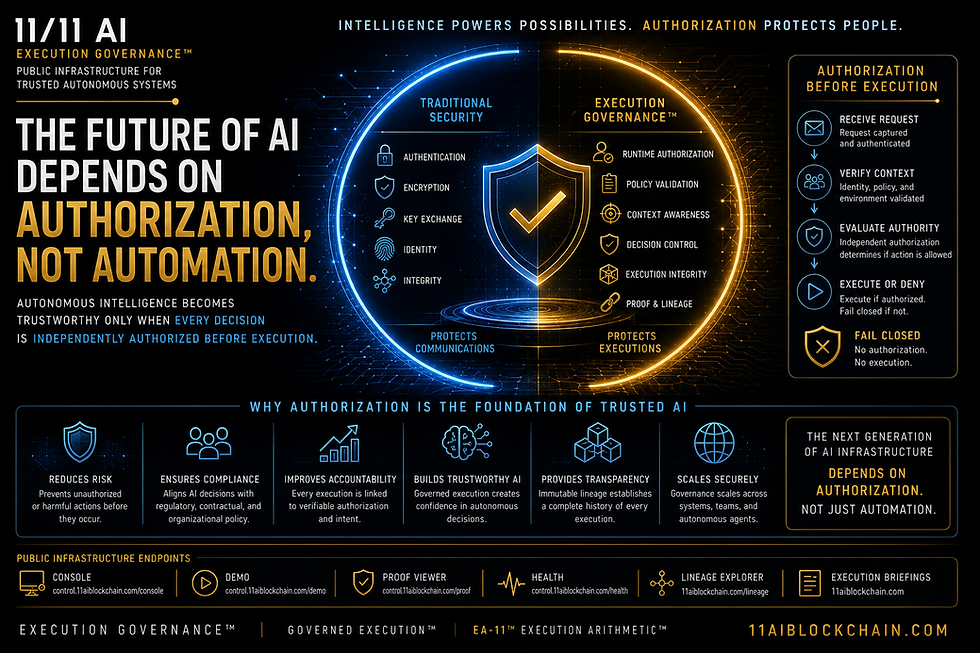
Execution Governance answers a different question.
Was the system authorized to perform the task?
This distinction creates an entirely new category of assurance.
Traditional benchmarks evaluate:
Accuracy
Reasoning
Speed
Context utilization
Coding ability
Task completion
Execution Governance evaluates:
Identity Verification
Authority Validation
Policy Enforcement
Runtime Controls
Authorization Assurance
Execution Lineage
Governance Coverage
Attestation Integrity
Proof Generation
One measures capability.
The other measures trust.
Both matter.
Only one determines whether execution should occur.
The Emergence Of The Authorization Economy
As autonomous systems become integrated into every industry, authorization becomes an economic asset.
Organizations capable of proving authority gain trust.
Organizations capable of proving governance reduce risk.
Organizations capable of proving execution assurance attract adoption.
This creates a new competitive advantage.
Not smarter systems.
More trusted systems.
Not greater autonomy.
Governed autonomy.
Not faster execution.
Authorized execution.
The winners of the next decade may not be those with the highest benchmark scores.
The winners may be those capable of proving authority before execution occurs.
Authorization As Infrastructure
Historically, trust has always evolved into infrastructure.
The internet required:
Public Key Infrastructure
Certificate Authorities
Identity Systems
Authentication Frameworks
Access Controls
Artificial intelligence is now approaching the same transition.
The industry increasingly requires:
Execution Governance
Runtime Authorization
Policy Enforcement
Governance Attestation
Execution Assurance
Proof Infrastructure
These systems do not replace intelligence.
They make intelligence trustworthy.
The Future Of Autonomous Systems
The future of artificial intelligence will not be determined solely by capability.
Capability creates opportunity.
Authority creates trust.
Trust creates adoption.
Adoption creates markets.
Markets create economies.
The autonomous era therefore depends upon a new foundation.
A foundation built upon authorization.
A foundation built upon governance.
A foundation built upon proof.
A foundation built upon trust infrastructure.
This is the Authorization Economy.
And the Authorization Economy requires Execution Governance.
Key Principle
Intelligence Creates Possibilities.
Authority Creates Outcomes.
Trust Creates Economies.
Execution Governance Creates Trust.
Public Infrastructure Endpoints
Public Runtime Infrastructure
Public Governance Consolehttps://control.11aiblockchain.com/console
Runtime Governance Demohttps://control.11aiblockchain.com/demo
Public Governance Proof Viewerhttps://control.11aiblockchain.com/proof
Infrastructure Health Dashboardhttps://control.11aiblockchain.com/health
Execution Lineage Explorerhttps://www.11aiblockchain.com/lineage
Execution Governance™
Governed Execution™
EA-11™ Execution Arithmetic™
EGBP™ Execution Governance Benchmark Project
Patent Pending


Comments