
PILLAR PAGE 01 What Is Execution Governance?


Introduction
Modern AI infrastructure is increasingly capable of autonomous execution.
AI systems now:
orchestrate infrastructure
trigger operational workflows
execute regulated compute actions
coordinate distributed runtimes
automate machine-speed decisions
Traditional security models were not designed for autonomous execution environments.
Most infrastructure security systems still operate using:
monitoring
observability
telemetry analysis
after-the-fact detection
post-execution response
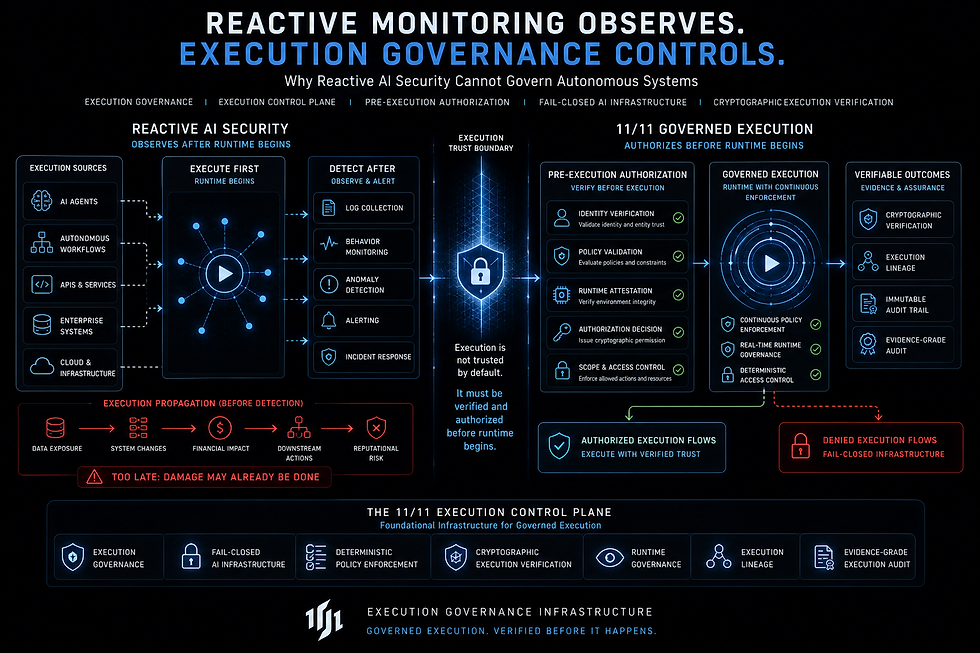
Those systems observe execution after runtime activation occurs.
Execution governance introduces a fundamentally different model:
verify before execution.
Execution governance establishes deterministic control over whether execution is allowed to occur in the first place.
No action executes without authorization.
The Problem With Traditional Security Models
Traditional infrastructure security assumes:
workloads are implicitly trusted
execution may proceed first
problems can be detected later
response occurs after runtime activation
That model increasingly fails under autonomous compute conditions.
By the time unauthorized execution is detected:execution has already occurred.
This creates a major infrastructure problem for:
AI systems
autonomous agents
distributed runtime environments
regulated compute systems
financial execution infrastructure
defense autonomy systems
Execution itself becomes the operational trust boundary.
What Execution Governance Does
Execution governance establishes:
pre-execution authorization
deterministic runtime enforcement
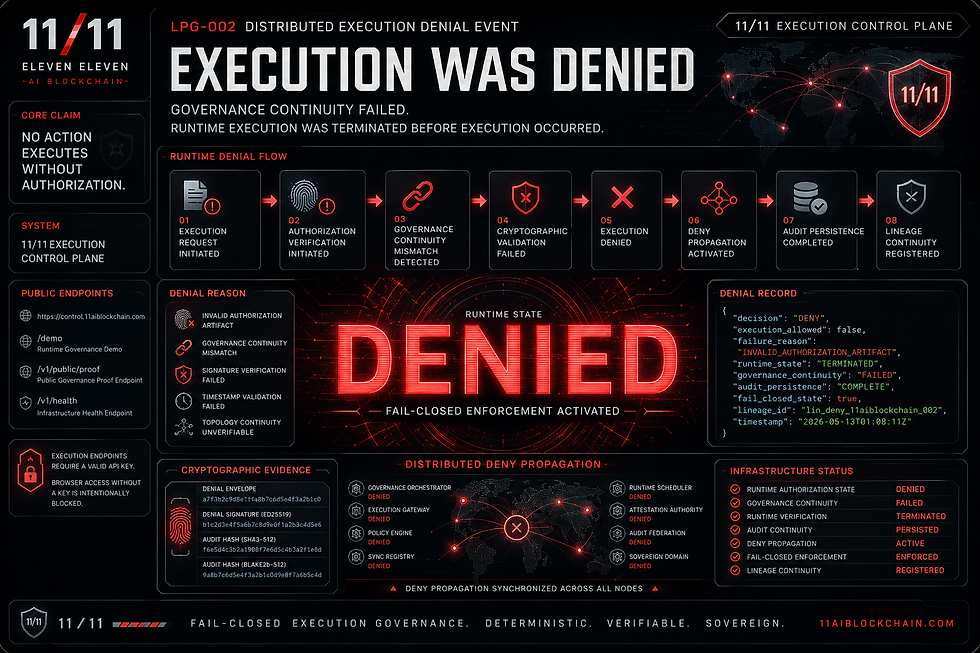
fail-closed operational control
immutable execution lineage
cryptographic runtime verification
continuous runtime integrity validation
Instead of:“execute first, inspect later”
execution governance establishes:“authorize before execution.”
Core Principles of Execution Governance
1. Pre-Execution Authorization
Every execution request must be evaluated before runtime activation.
The system determines:
identity
context
policy validity
environment trust
authorization state
execution eligibility
Unauthorized execution fails closed.
2. Fail-Closed Enforcement
Execution governance assumes:
unauthorized execution must never proceed
policy uncertainty defaults to deny
runtime trust cannot be inferred implicitly
No authorization:no execution.
3. Runtime Enforcement
Governance does not stop after authorization.
Execution governance continuously enforces:
policy integrity
runtime integrity
environment consistency
behavioral constraints
state verification
drift detection
Governance persists throughout runtime execution.
4. Cryptographic Verification
Execution governance establishes verifiable runtime trust through:
signed authorization artifacts
cryptographic execution verification
immutable audit persistence
execution lineage validation
deterministic evidence generation
Runtime trust becomes:provable.
5. Immutable Execution Lineage
Every execution event becomes:
recorded
linked
traceable
verifiable
immutable
Execution lineage establishes persistent operational accountability.
Execution Governance vs Observability
Observability systems:
monitor runtime activity
collect telemetry
inspect logs
analyze after execution
Execution governance:
authorizes before execution
enforces during runtime
fails closed on violation
verifies continuously
Observability watches systems.
Execution governance controls systems.
Why AI Requires Execution Governance
Autonomous systems increasingly:
initiate actions independently
coordinate infrastructure
execute workflows continuously
operate at machine speed
Human-speed oversight no longer scales.
AI infrastructure requires:
deterministic authorization
continuous runtime verification
policy enforcement before execution
fail-closed operational semantics
Execution governance becomes mandatory infrastructure for autonomous compute systems.
Execution Governance Architecture
Execution governance infrastructure typically includes:
Governance Control Plane
policy engine
authorization engine
risk evaluation
integrity verification
lineage services
Runtime Enforcement Layer
runtime guards
integrity monitors
enforcement engines
anomaly detection
fail-closed controls
Execution Infrastructure
compute
containers
orchestration
runtime services
distributed infrastructure
Public Execution Governance Infrastructure
11/11 public execution governance infrastructure is operational:
Public Governance Console
Runtime Governance Demo
Public Governance Proof Viewer
Infrastructure Health Dashboard
Execution Lineage Explorer
Execution Governance Is Emerging Infrastructure
Execution governance increasingly becomes:
foundational infrastructure
runtime trust infrastructure
autonomous execution control
operational AI governance
deterministic runtime enforcement
The shift resembles the emergence of:
Zero Trust
Kubernetes admission control
infrastructure attestation
cryptographic trust systems
Execution governance establishes:the control layer for autonomous compute systems.
Conclusion
Execution governance changes the operational model of modern infrastructure.
Execution can no longer rely on:
inferred trust
reactive monitoring
post-execution analysis
delayed response
Execution must become:
authorized
governed
continuously verified
cryptographically provable
fail-closed by design
11/11 is building the execution governance layer for AI and regulated compute infrastructure.

Comments