
Why AI Authorization Must Become Infrastructure


The first generation of artificial intelligence governance focused primarily on model behavior.
The second generation focused on transparency.
The third generation focused on auditing.
None of these solve the fundamental problem.
A system can still execute an action before anyone determines whether that action should have been allowed.
This is the architectural gap that continues to exist across nearly every AI deployment today.
The question is no longer:
"Can we explain what happened?"
The question is:
"Should the system have been permitted to act in the first place?"
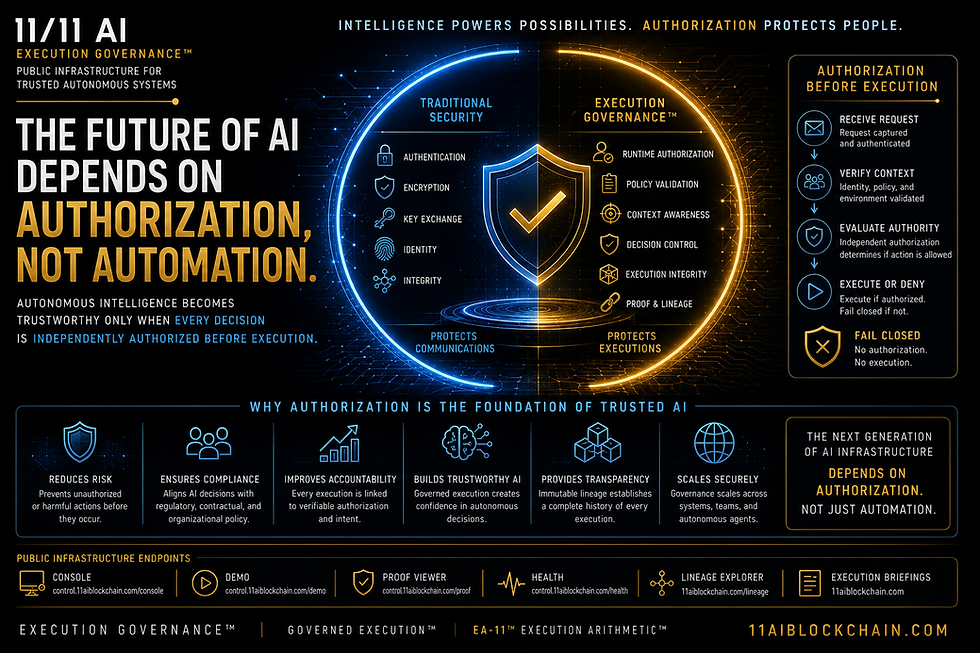
Execution Governance introduces a new infrastructure layer designed to answer that question before execution occurs.
This distinction is critical.
Traditional governance frameworks operate after execution.
Execution Governance operates before execution.
The difference appears subtle.
It is not.
The difference determines whether governance is preventive or forensic.
For decades, computing infrastructure has relied on authorization systems before actions occur.
A user cannot access a secure network without authorization.
A device cannot join a protected domain without authorization.
A certificate cannot be trusted without validation.
AI systems increasingly possess the ability to:
Access tools
Control workflows
Trigger transactions
Operate autonomous agents
Direct physical systems
Execute business processes
Interact with critical infrastructure
Yet most deployments still lack a universal authorization framework governing execution itself.
This creates an imbalance.
The more capable autonomous systems become, the more dangerous post-execution governance becomes.
Observability alone cannot stop execution.
Logging alone cannot stop execution.
Monitoring alone cannot stop execution.
Auditing alone cannot stop execution.
The action has already occurred.
The infrastructure challenge therefore becomes clear.
Before any execution event occurs, a system must answer several fundamental questions:
Who is requesting execution?
What authority exists?
What permissions apply?
What policy governs the action?
What environmental conditions are required?
What verification has been completed?
What proof exists that authorization occurred?
Execution Governance treats these questions as mandatory runtime requirements.
Execution is no longer assumed.
Execution must be authorized.
This principle forms the foundation of Governed Execution.
In a Governed Execution architecture:
Verification occurs before runtime.
Authorization occurs before runtime.
Policy validation occurs before runtime.
Execution occurs only after successful validation.
Proof is generated after execution.
The result is a fail-closed operational model.
If authorization cannot be proven, execution does not occur.
This approach mirrors the evolution of the internet itself.
The internet did not become trusted because websites existed.
The internet became trusted because infrastructure layers emerged.
SSL.
TLS.
Public Key Infrastructure.
Certificate Authorities.
Identity Systems.
Authentication Layers.
Authorization Frameworks.
Trust became infrastructure.
Artificial intelligence is now approaching the same transition.
Models are no longer the primary challenge.
Execution authority is.
The organizations that solve authorization will define the next generation of AI infrastructure.
The future of AI governance will not be determined by larger models.
It will be determined by stronger execution controls.
The next decade will belong to systems capable of proving not only what happened, but why an action was permitted to occur at all.
That is the objective of Execution Governance.
Not observation.
Authorization.
Not auditing.
Control.
Not explanation.
Authority.
The transition from Artificial Intelligence to Governed Intelligence begins at the
execution boundary.
And the execution boundary is becoming critical infrastructure.
Public Infrastructure Endpoints
Public Runtime Infrastructure
Public Governance Console
Runtime Governance Demo
Public Governance Proof Viewer
Infrastructure Health Dashboard
Execution Lineage Explorer
Execution Governance™ Governed Execution™ EA-11™ Execution Arithmetic™
Patent Pending
Public Infrastructure Endpoints
Execution endpoints intentionally require valid API authorization.
Browser access without a valid authorization key is fail-closed by design.


Comments