
Why Autonomous Trading Requires Execution Governance
- 11/11 AI

- Jun 12
- 3 min read

Financial markets were designed around a fundamental assumption.
A human ultimately authorizes execution.
Even in highly automated environments, authority remains traceable to a human actor, a delegated mandate, a regulatory framework, or an approved operational boundary.
Artificial intelligence changes that assumption.
Modern systems can now:
Generate trading strategies
Analyze market conditions
Route orders
Allocate capital
Rebalance portfolios
Coordinate execution across venues
Manage liquidity positions
Interact with counterparties
Execute decisions without human intervention
This creates a new category of risk.
Not model risk.
Not market risk.
Not counterparty risk.
Execution risk.
Specifically:
Unauthorized autonomous execution.
The financial industry has spent decades building infrastructure to control who can move money, access accounts, settle transactions, and execute trades.
Every major financial institution operates under layers of authorization controls designed to answer a simple question:
Who has authority to perform this action?
The challenge is that autonomous systems increasingly operate faster than traditional authorization frameworks were designed to support.
A machine may generate thousands of execution decisions per second.
A machine may dynamically modify behavior based on changing market conditions.
A machine may coordinate activity across multiple systems simultaneously.
Traditional approval workflows cannot operate at machine speed.
The result is an authorization vacuum.
The industry currently focuses heavily on:
Model governance.
Algorithm validation.
Trade surveillance.
Market monitoring.
Operational controls.
Post-event investigation.
All are important.
None answer the most important question.
Was the system authorized to execute?
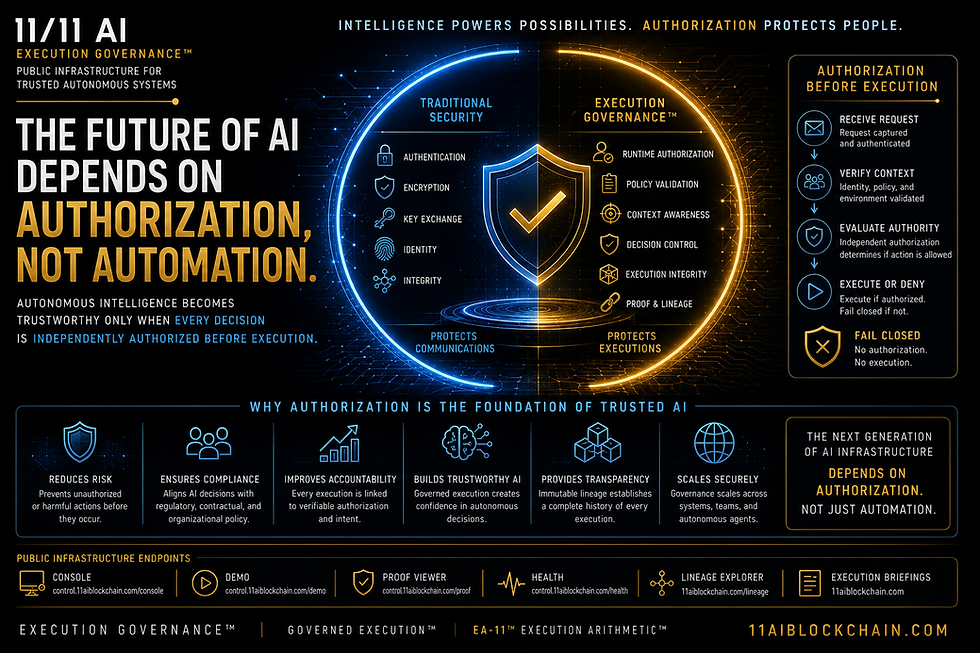
Execution Governance introduces a dedicated authorization fabric between intelligence generation and market execution.
This fabric evaluates:
Identity.
Authority.
Policy.
Risk.
Environmental conditions.
Execution permissions.
Only after successful validation does execution become possible.
This changes the architecture of autonomous finance.
Instead of:
Decision → Execution → Audit
The model becomes:
Decision → Verification → Authorization → Execution → Proof
This distinction appears small.
Operationally it is transformational.
Because unauthorized execution never occurs.
The execution boundary itself becomes governed.
Within institutional trading environments this enables:
Policy-controlled strategy deployment.
Authority-bound order generation.
Risk-aware execution validation.
Venue-specific governance controls.
Position limit enforcement.
Delegated execution authorities.
Cryptographic execution attestation.
Regulatory lineage generation.
Most importantly, it creates machine-speed trust.
Trust is often misunderstood within financial infrastructure.
Trust does not emerge from intelligence.
Trust emerges from control.
A system is not trusted because it is intelligent.
A system is trusted because its authority is understood.
Financial institutions already apply this principle to humans.
Execution Governance extends the same principle to autonomous systems.
As AI becomes embedded within:
Trading desks
Prime brokerage operations
Market-making systems
Treasury organizations
Custody platforms
Digital asset infrastructure
Global settlement networks
The need for execution authorization becomes unavoidable.
Markets cannot operate on intelligence alone.
Markets operate on authority.
Authority determines who may act.
Authority determines what actions are permitted.
Authority determines when execution is allowed.
Authority determines accountability.
Execution Governance transforms these principles into runtime infrastructure.
Not policy documents.
Not compliance manuals.
Not audit reports.
Infrastructure.
Infrastructure capable of enforcing authority before execution occurs.
The future of autonomous trading will not be determined by which system produces the most sophisticated decisions.
It will be determined by which system can prove that every decision was authorized before execution.
That is the difference between automation and governed autonomy.
And governed autonomy is the foundation of trusted financial infrastructure.
Because in global markets, execution is not the product.
Trust is the product.
Execution Governance makes trust executable.
Public Infrastructure Endpoints
Public Runtime Infrastructure
Public Governance Consolehttps://control.11aiblockchain.com/console
Runtime Governance Demohttps://control.11aiblockchain.com/demo
Public Governance Proof Viewerhttps://control.11aiblockchain.com/proof
Infrastructure Health Dashboardhttps://control.11aiblockchain.com/health
Execution Lineage Explorerhttps://www.11aiblockchain.com/lineage
Execution Governance™
Governed Execution™
EA-11™ Execution Arithmetic™
Patent Pending
Public Infrastructure Endpoints
11/11 AI Research Division
Trust Is Infrastructure™
Verify Before Runtime™Authorize Before Runtime™Prove After Runtime™
Execution Is No Longer Assumed.Execution Must Be Authorized™


Comments