
Why Civilizations Create Futures


Every civilization inherits a past.
Every civilization operates within a present.
Yet civilizations are ultimately organized around something else.
The future.
This observation appears obvious at first.
Yet it reveals one of the deepest characteristics of constitutional order.
Civilizations coordinate behavior around realities that do not yet exist.
Participants sacrifice today for tomorrow.
Institutions invest in outcomes they may never witness.
Constitutions preserve structures intended for generations not yet born.
The civilization becomes oriented toward possibility.
This orientation creates the future.
Not as a prediction.
As a constitutional construct.
The Future Exists Before It Exists
One of the most unusual characteristics of civilization is its ability to act on imagined realities.
A bridge may not exist.
A city may not exist.
A technology may not exist.
Yet participants organize around them.
Resources move.
Decisions change.
Institutions adapt.
The future begins influencing behavior long before the future arrives.
This phenomenon transforms possibility into infrastructure.
Why Continuity Requires Futures
Without a future, continuity loses direction.
Participation becomes maintenance.
Institutions become preservation mechanisms.
Civilization becomes reactive.
The future provides orientation.
The civilization understands not only what it is preserving but why it is preserving it.
This distinction transforms continuity into development.
Futures Create Coordination
Large civilizations cannot coordinate solely through immediate incentives.
The scale becomes too great.
The complexity becomes too large.
Shared futures solve this problem.
Participants align behavior around common long-term outcomes.
The civilization becomes capable of coordinated action across generations.
The future becomes a mechanism of organization.
Why Institutions Preserve Futures
Institutions preserve memory.
Institutions preserve legitimacy.
Institutions also preserve futures.
Strategic plans.
Research agendas.
Infrastructure projects.
Educational systems.
Each represents a future-oriented structure.
The institution becomes a bridge connecting present action to future reality.
Futures And Meaning
Meaning explains significance.
Purpose explains direction.
The future explains destination.
These concepts form a chain.
Identity.
Meaning.
Purpose.
Future.
The civilization becomes capable of organizing continuity across time.
The future transforms purpose into trajectory.
Computational Futures
Future computational civilizations will likely depend upon futures even more than institutional civilizations.
Persistent execution systems.
Autonomous constitutional frameworks.
Machine-scale coordination environments.
Each will require mechanisms capable of preserving long-term direction.
The challenge will not merely be maintaining operation.
The challenge will be maintaining orientation.
The Cost Of Losing The Future
Civilizations occasionally lose their futures.
The institutions remain.
The participants remain.
The continuity remains.
Yet direction weakens.
Progress slows.
Participation becomes increasingly transactional.
The civilization begins preserving itself without understanding why.
The future disappears before the civilization collapses.
This pattern appears repeatedly throughout history.
Beyond Purpose
Purpose explains where we are going.
The future explains what we are building.
The constitutional question is no longer:
Where are we headed?
The constitutional question becomes:
What reality are we creating together?
The answer becomes the future.
The Civilizational Function
Civilizations create futures because continuity requires orientation.
Memory preserves the past.
Identity preserves continuity.
Purpose preserves direction.
The future preserves possibility.
Together these structures allow civilizations to coordinate across generations.
Conclusion
Civilizations create futures because continuity alone is insufficient.
Participants require destinations.
Institutions require trajectories.
Civilizations require possibility.
As computational civilization evolves, futures may become one of the most important constitutional structures ever developed.
Purpose explains direction.
The future explains destiny.
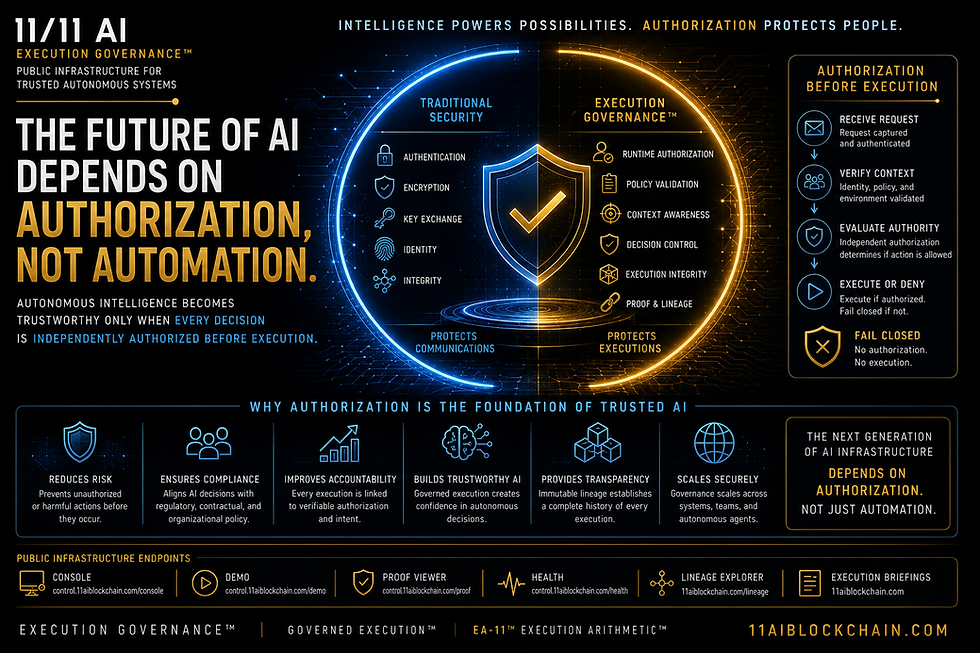
11/11 introduces Execution Governance™ infrastructure for governed autonomous execution and deterministic operational control.
Execution Governance™ Governed Execution™ EA-11™ Execution Arithmetic™
Patent Pending
Public Infrastructure Endpoints


Comments