
Why EA-11 Introduces Computational Identity


Modern systems assign identity to people, devices, applications, and services.
EA-11 asks a deeper question:
What is the identity of the computation itself?
Historically, computation has been treated as anonymous.
A process executes.
A result is generated.
An outcome is produced.
The system moves forward.
Little attention is given to the identity of the computational event.
That assumption becomes increasingly problematic in autonomous systems.
Machine-speed infrastructure continuously generates computational outcomes that influence:
sovereign AI systems
autonomous orchestration
healthcare infrastructure
financial platforms
defense environments
critical infrastructure
distributed execution systems
In these environments, anonymous computation becomes a governance problem.
Without identity:
authority becomes difficult to establish
trust becomes uncertain
accountability weakens
provenance degrades
legitimacy becomes difficult to defend
This is where EA-11 introduces computational identity.
Computational identity establishes that every authoritative computation must possess a verifiable identity before it becomes operationally admissible.
A computation is not merely a result.
It is an operational event.
And operational events require identity.
Computational identity enables a system to answer:
What computation occurred?
Who initiated it?
Under what trust conditions?
Under what policy conditions?
Under what runtime conditions?
Within what authority framework?
Inside what admissibility boundaries?
Without identity, these questions become difficult to answer.
This creates a new computational distinction.
Anonymous Computation
A result exists.
Identified Computation
A result exists and possesses a verifiable operational identity.
This distinction becomes increasingly important as autonomous infrastructure scales.
Because future systems will not merely depend on computational outcomes.
They will depend on trusted computational actors.
EA-11 therefore introduces identity as a computational property.
Not merely a user property.
Not merely a device property.
A computational property.
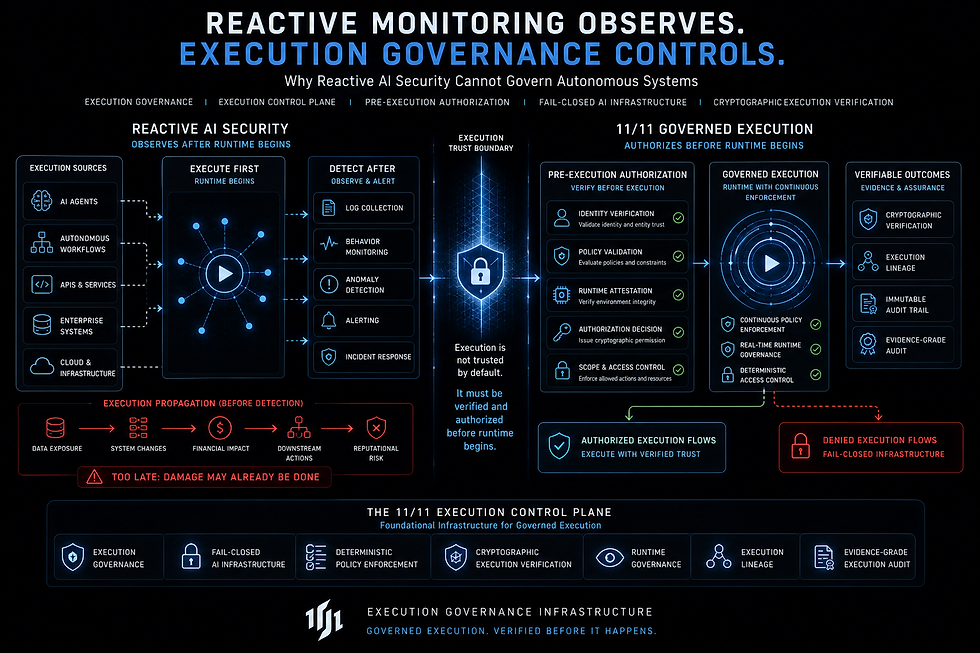
Execution Governance™ establishes execution identity.
EA-11 establishes computational identity.
Together they create:
governed execution
governed computation
computational citizenship
computational identity
computational authority
deterministic operational trust
As autonomous systems continue expanding globally, identity becomes increasingly important.
Because future infrastructure will not simply ask:
What was computed?
It will ask:
Which computation earned the right to be trusted?
That answer requires identity.
That is why EA-11 introduces computational identity.
Public Infrastructure Endpoints
Public Runtime Infrastructure
Public Governance Console
Runtime Governance Demo
Public Governance Proof Viewer
Infrastructure Health Dashboard
Execution Lineage Explorer
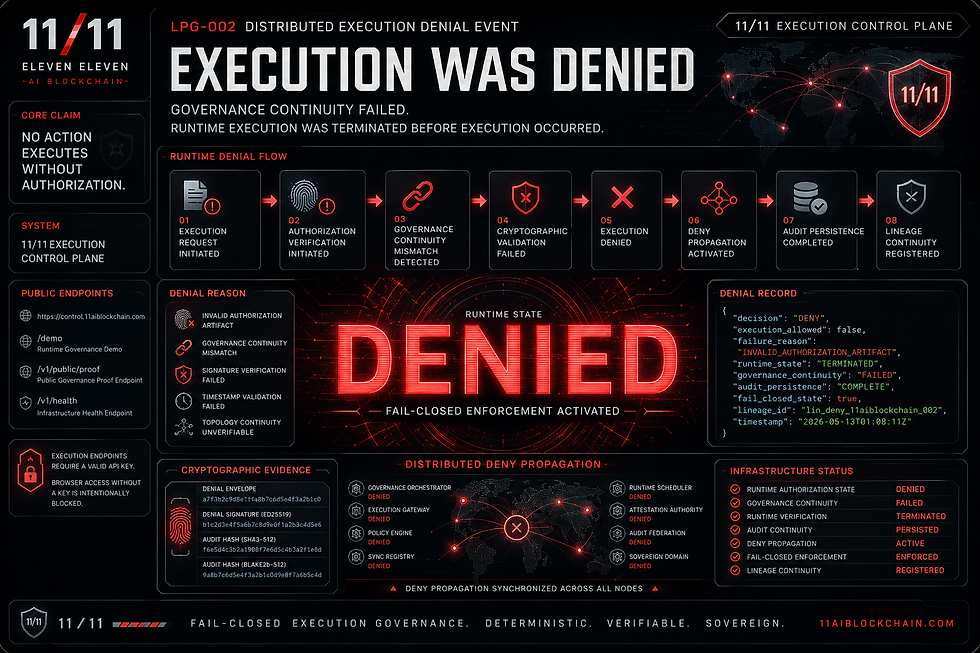
Execution endpoints intentionally require valid API authorization.
Browser access without a valid authorization key is fail-closed by design.
EA-11™ Execution Arithmetic™ Governed Computation™ Patent Pending

Comments