
EG-008 Deterministic Policy Enforcement

Updated: May 13

Governed execution requires predictable governance behavior.
Modern infrastructure already depends on deterministic systems:
cryptographic verification
transaction settlement
consensus validation
networking protocols
infrastructure orchestration
Execution governance now requires:deterministic policy enforcement.
11/11 defines Deterministic Policy Enforcement as the canonical governance model where identical runtime conditions produce identical policy enforcement outcomes before and during execution.
Execution governance becomes mathematically consistent infrastructure.
What Is Deterministic Policy Enforcement?
Deterministic policy enforcement means:
governance outcomes remain predictable, consistent, and verifiable under identical runtime conditions.
If policy conditions succeed:execution proceeds.
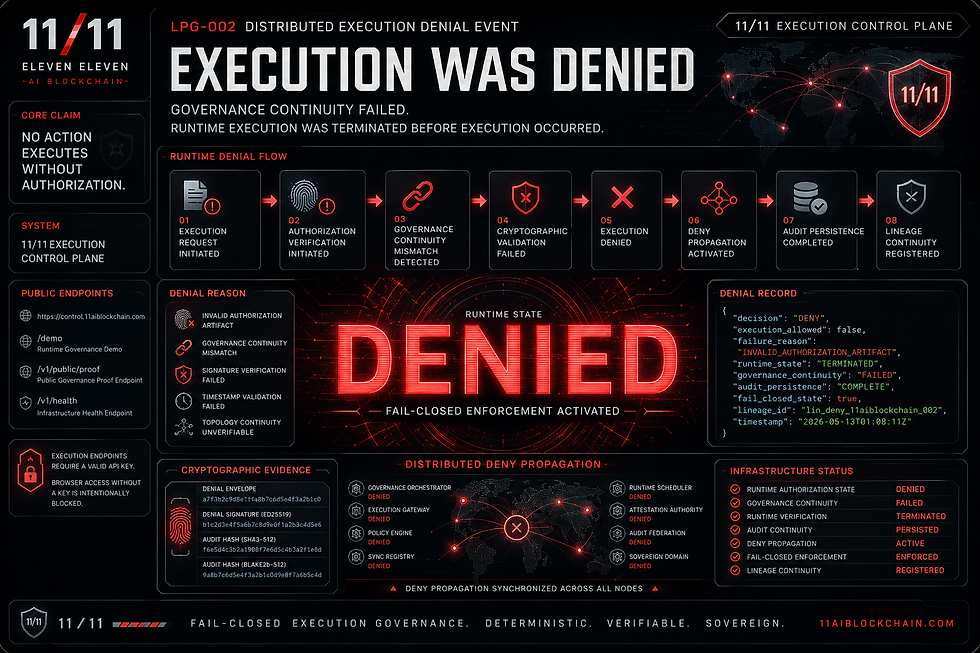
If policy conditions fail:execution is denied.
No ambiguity.
No discretionary interpretation.
No inconsistent runtime behavior.
Governance itself becomes deterministic infrastructure.
Why Deterministic Enforcement Matters
Without deterministic governance behavior:
policy enforcement drifts
runtime trust weakens
execution legitimacy becomes inconsistent
governance continuity fragments
authorization behavior becomes unreliable
Execution governance requires:
predictable runtime trust enforcement.
Deterministic policy systems establish the canonical governance behavior model for governed execution infrastructure.
EG-008 Deterministic Enforcement Principles
1. Policy Outcomes Must Remain Predictable
Identical governance conditions must produce identical execution outcomes.
Execution trust cannot vary unpredictably.
2. Invalid Governance States Must Fail Closed
If policy validation becomes:
invalid
unverifiable
inconsistent
uncertain
out of scope
execution must stop automatically.
No permissive fallback behavior.
3. Authorization Validation Must Remain Deterministic
Authorization artifacts must be evaluated using deterministic validation logic.
Execution approval cannot rely on subjective interpretation.
4. Governance Enforcement Must Remain Infrastructure-Native
Applications cannot self-govern policy enforcement behavior.
The governance layer itself must independently enforce deterministic runtime controls.
5. Execution Lineage Must Preserve Enforcement Continuity
Lineage systems must preserve:
policy evaluations
authorization decisions
runtime trust transitions
governance outcomes
enforcement history
Governance continuity must remain historically provable.
Deterministic Governance Becomes Infrastructure-Critical
Future enterprise and sovereign systems increasingly require:
deterministic runtime governance
predictable policy enforcement
fail-closed authorization systems
cryptographic execution verification
immutable governance continuity
operational trust consistency
Execution governance becomes predictable operational infrastructure.
Autonomous Infrastructure Requires Consistent Governance
Autonomous systems increasingly operate:
continuously
asynchronously
independently
across distributed environments
at machine speed
Execution governance cannot depend on discretionary runtime interpretation.
Runtime trust itself must become deterministic.
Deterministic enforcement establishes the canonical governance behavior primitive for autonomous infrastructure.
Deterministic Enforcement Changes Infrastructure Semantics
Historically:
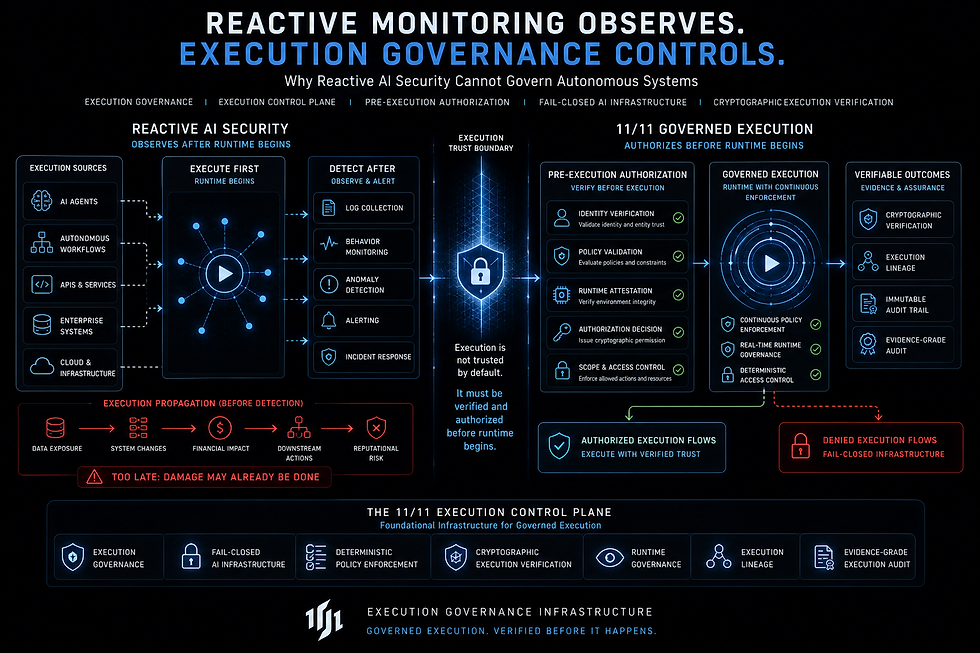
governance systems relied on reactive interpretation.
Execution governance introduces:
deterministic runtime trust enforcement.
Future infrastructure increasingly governs:
whether execution is authorized
whether policy conditions remain valid
whether runtime trust persists
whether governance continuity remains intact
whether execution remains compliant
Governance behavior itself becomes governed infrastructure.
11/11 Positioning
11/11 is positioned as the execution governance layer for AI infrastructure.
Its governance architecture establishes:
deterministic policy enforcement
governed runtime authorization
fail-closed governance controls
cryptographic runtime verification
immutable execution lineage
operational trust continuity
before and during execution.
Execution itself becomes the trust boundary.
Official Proof Systems
Public Governance Console
Runtime Governance Demo
Public Governance Proof Viewer
Infrastructure Health Dashboard
Execution Lineage Explorer
Execution governance cannot rely on inconsistent runtime behavior.
Trust itself must become deterministic infrastructure.

Comments