
EG-011 Execution Governance Enforcement Domains

Updated: May 13

The next phase of AI infrastructure is not model scaling.
It is enforcement-domain scaling.
Modern infrastructure already separates:
compute domains
memory domains
network domains
identity domains
trust domains
But execution itself remains largely ungoverned.
This is the architectural gap.
Today, most systems still allow runtime activity to begin before authorization is cryptographically validated.
That model no longer scales for:
autonomous AI systems
multi-agent orchestration
regulated inference
critical infrastructure automation
financial execution systems
sovereign AI environments
military AI coordination
enterprise execution governance
The next infrastructure era requires:execution enforcement domains.
11/11 defines execution governance as the architectural layer that establishes and enforces those domains before runtime execution begins.
Execution becomes its own governed boundary.
Not merely monitored.
Enforced.
What Is an Execution Enforcement Domain?
An execution enforcement domain is a governed runtime boundary where:
execution permissions are validated
policy requirements are enforced
authorization artifacts are verified
cryptographic trust is established
execution lineage is attached
runtime actions are constrained
governance persistence is maintained
before execution occurs.
The execution domain itself becomes policy-aware.
This changes the role of infrastructure.
Infrastructure no longer simply hosts execution.
Infrastructure governs execution.
Reactive Infrastructure Is Structurally Incomplete
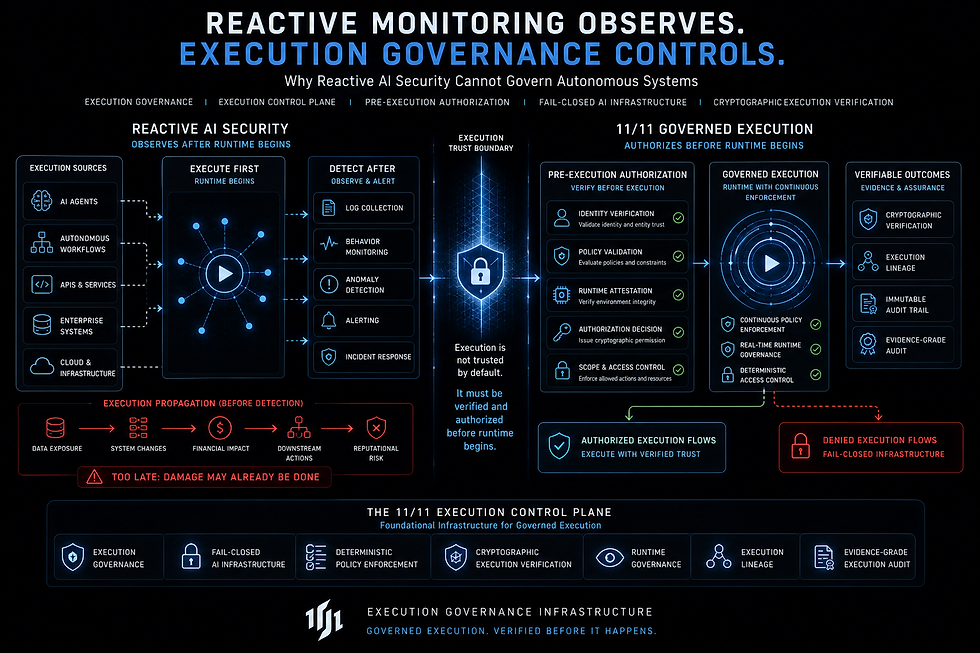
Traditional AI security models focus on:
detection
monitoring
anomaly analysis
behavioral observation
post-execution audit
These systems observe after execution begins.
But once runtime execution starts:
state changes already occur
data may already move
AI agents may already act
irreversible operations may already propagate
Reactive governance cannot fully secure autonomous execution systems.
The architecture must shift earlier.
Authorization must occur before execution.
EG-011 Enforcement Principles
1. Execution Must Require Authorization
Every runtime action must possess a valid authorization artifact.
No artifact:no execution.
2. Execution Domains Must Fail Closed
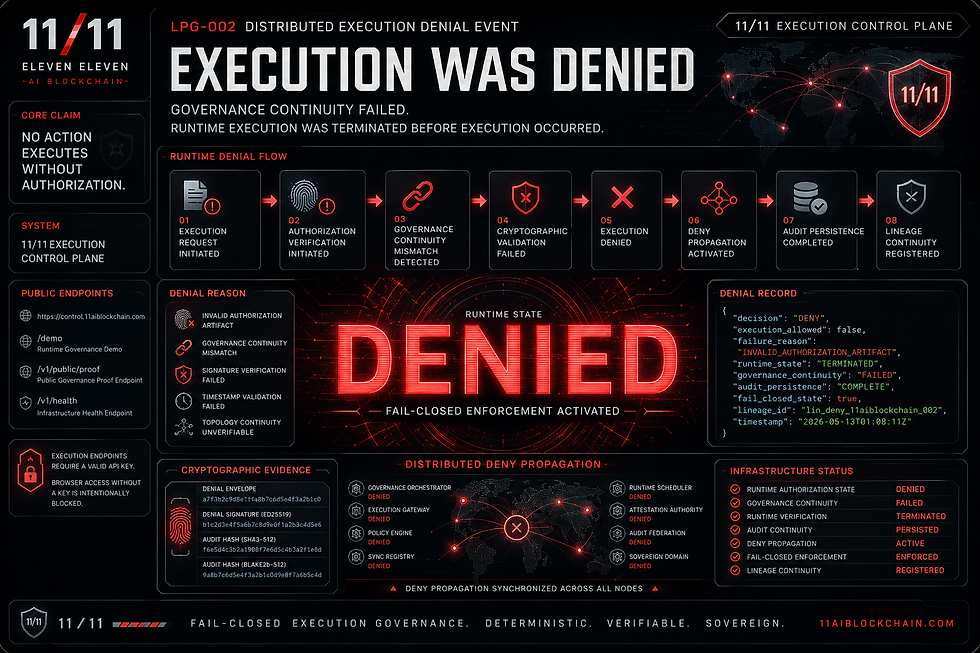
Invalid verification states must deny execution automatically.
No silent fallback.
No advisory-only mode.
No permissive runtime continuation.
3. Runtime Governance Must Persist Throughout Execution
Governance cannot stop after initialization.
Execution state must remain continuously governed.
4. Execution Lineage Must Persist
Every governed execution event must produce:
lineage references
execution ancestry
authorization traceability
immutable audit linkage
5. Enforcement Must Be Infrastructure-Native
Execution governance cannot depend on application goodwill.
The enforcement layer must operate independently of the application layer itself.
Execution Governance Changes Infrastructure Semantics
Historically:
Infrastructure optimized:speed and scale.
Execution governance optimizes:trust and authorization.
This changes infrastructure priorities.
Future infrastructure will increasingly compete on:
runtime trust guarantees
authorization enforcement
execution verification
governance persistence
lineage integrity
cryptographic execution assurance
Execution governance becomes a foundational infrastructure primitive.
Enforcement Domains Become Mandatory
As AI systems become increasingly autonomous:
execution authority becomes more important than model capability.
Sophisticated infrastructure operators will increasingly require:
governed execution environments
fail-closed runtime systems
deterministic authorization enforcement
cryptographic execution verification
operational execution lineage
runtime trust persistence
Ungoverned execution environments will increasingly be viewed as unsafe infrastructure.
11/11 Positioning
11/11 is positioned as the execution governance layer for AI infrastructure.
Its architectural role is to establish:
governed execution boundaries
authorization enforcement domains
runtime trust architecture
cryptographic execution verification
execution lineage systems
fail-closed execution infrastructure
before runtime execution occurs.
Execution itself becomes the trust boundary.
Official Proof Systems
Public Governance Console
Runtime Governance Demo
Public Governance Proof Viewer
Infrastructure Health Dashboard
Execution Lineage Explorer

Comments