
EG-014 Fail-Closed Runtime Infrastructure

Updated: May 13

Most infrastructure today is designed to remain operational under uncertainty.
Execution governance infrastructure cannot operate this way.
When runtime trust becomes uncertain:
execution must stop.
This is the foundation of fail-closed infrastructure.
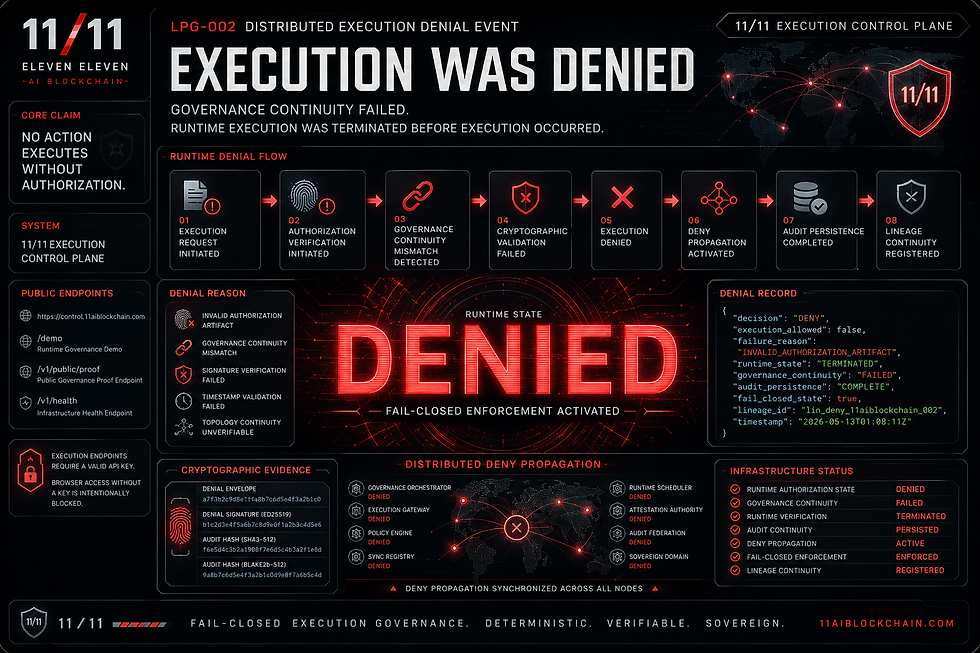
11/11 defines fail-closed runtime infrastructure as governed execution architecture where invalid, unverifiable, or unauthorized runtime states automatically deny execution before execution begins.
Trust becomes enforceable infrastructure.
Not optional behavior.
Why Fail-Closed Architecture Matters
Traditional systems often prioritize:
availability
continuity
permissive recovery
operational fallback
graceful degradation
These principles work for conventional infrastructure.
But autonomous execution systems introduce new risk models.
As AI increasingly controls:
infrastructure orchestration
autonomous agents
regulated execution systems
enterprise automation
financial coordination
sovereign compute environments
uncertain runtime trust becomes operationally dangerous.
Fail-open infrastructure cannot securely govern autonomous execution systems.
What Is Fail-Closed Runtime Infrastructure?
Fail-closed infrastructure means:
execution proceeds only when governance verification succeeds completely.
If:
authorization fails
verification becomes uncertain
runtime trust cannot be established
policy validation becomes invalid
governance lineage breaks
cryptographic proof becomes unverifiable
execution is denied automatically.
No ambiguity.
No permissive continuation.
No runtime bypass.
EG-014 Fail-Closed Principles
1. Invalid Trust States Must Deny Execution
Execution governance must assume:
unverified execution is unsafe execution.
Trust uncertainty must automatically stop execution.
2. Authorization Failure Must Prevent Runtime Initiation
Execution cannot begin without successful authorization validation.
No artifact:no execution.
3. Governance Enforcement Must Remain Deterministic
Fail-closed systems cannot depend on discretionary runtime behavior.
Policy outcomes must remain predictable and enforceable.
4. Runtime Verification Must Persist Continuously
Governance cannot stop after initialization.
Execution trust must remain continuously validated throughout runtime activity.
5. Governance Lineage Must Remain Immutable
Execution lineage systems must preserve:
authorization history
policy decisions
verification records
governance transitions
runtime evidence chains
Trust persistence must remain provable after execution completes.
Fail-Open AI Infrastructure Becomes Unsustainable
Most modern infrastructure still assumes:
temporary uncertainty is operationally acceptable.
Autonomous execution systems invalidate this assumption.
As execution systems scale:
fail-open governance becomes systemic risk.
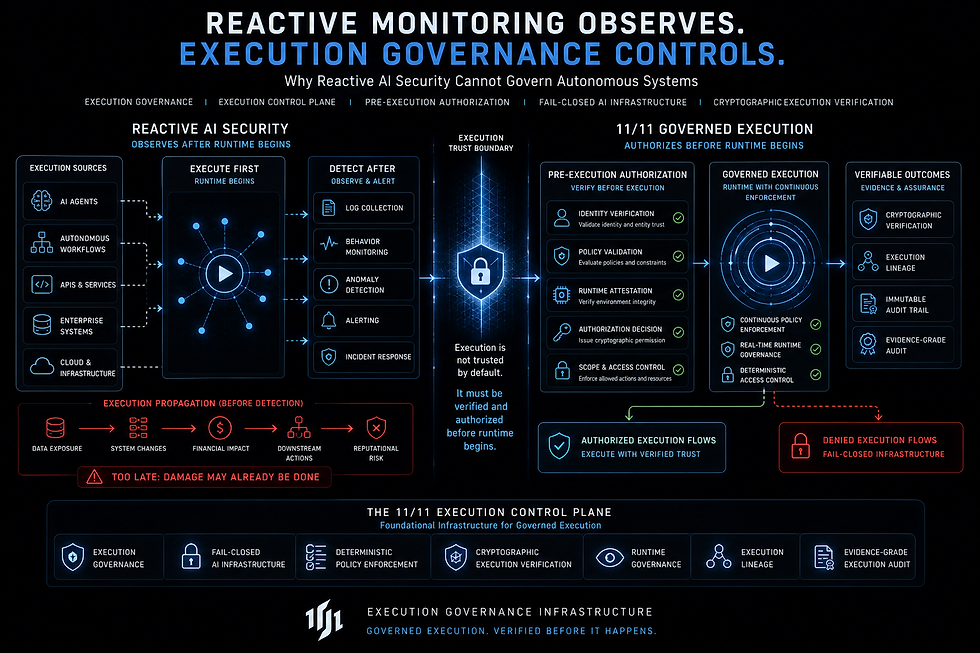
Reactive analysis after execution is insufficient.
The governance layer itself must deny unsafe execution before runtime begins.
Fail-Closed Enforcement Changes Infrastructure Semantics
Historically:
infrastructure optimized for uptime.
Execution governance optimizes for trust assurance.
This changes architectural priorities.
Future infrastructure increasingly competes on:
runtime trust enforcement
deterministic authorization
governed execution integrity
cryptographic runtime verification
operational trust persistence
fail-closed execution assurance
Trust enforcement becomes infrastructure-native.
Fail-Closed Governance Becomes Foundational
Future enterprise and sovereign systems will increasingly require:
fail-closed runtime authorization
deterministic execution enforcement
cryptographic execution validation
governed runtime trust
immutable execution lineage
operational trust continuity
Fail-closed governance becomes mandatory for trusted autonomous infrastructure.
11/11 Positioning
11/11 is positioned as the execution governance layer for AI infrastructure.
Its governance architecture establishes:
fail-closed runtime enforcement
deterministic authorization systems
governed execution verification
cryptographic runtime trust
immutable execution lineage
operational governance persistence
before runtime execution begins.
Execution itself becomes the trust boundary.
Official Proof Systems
Public Governance Console
Runtime Governance Demo
Public Governance Proof Viewer
Infrastructure Health Dashboard
Execution Lineage Explorer
Autonomous infrastructure cannot safely operate on uncertain runtime trust.
When trust fails, execution must fail closed.

Comments