
PILLAR PAGE 02 Why AI Requires Pre-Execution Authorization


Introduction
Modern AI systems are rapidly evolving from passive software into autonomous execution infrastructure.
AI runtimes increasingly:
initiate actions independently
orchestrate infrastructure
coordinate workflows
manage operational systems
trigger machine-speed execution
interact with regulated environments
Traditional security architectures were not designed for autonomous execution systems.
Most existing security infrastructure still assumes:
execution can proceed first
monitoring occurs afterward
response happens later
runtime trust is implicitly assumed
That model no longer scales.
AI infrastructure increasingly requires:
pre-execution authorization.
No action executes without authorization.
The Core Problem
Traditional infrastructure security focuses primarily on:
observability
telemetry
logging
anomaly detection
post-execution analysis
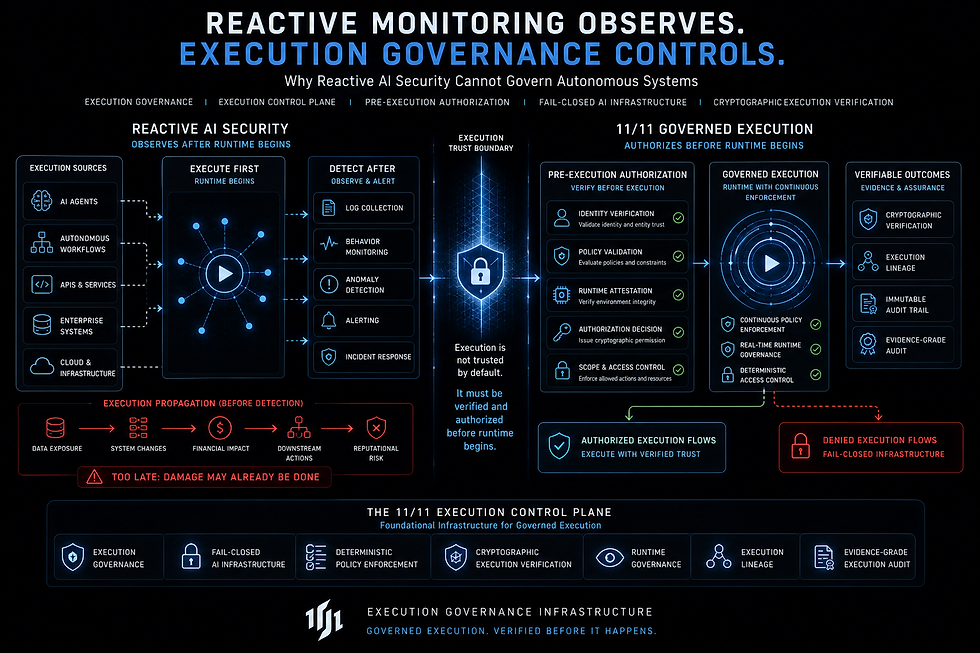
These systems observe execution after runtime activation.
By the time detection occurs:execution has already happened.
For autonomous systems:that becomes operationally dangerous.
AI systems can now:
modify infrastructure
access sensitive systems
orchestrate distributed runtimes
trigger financial operations
execute chained workflows
operate continuously at machine speed
Execution itself becomes the operational trust boundary.
What Pre-Execution Authorization Means
Pre-execution authorization establishes deterministic control before runtime activation occurs.
Before execution begins:the system verifies:
identity
policy validity
context
intent
environment integrity
authorization state
runtime eligibility
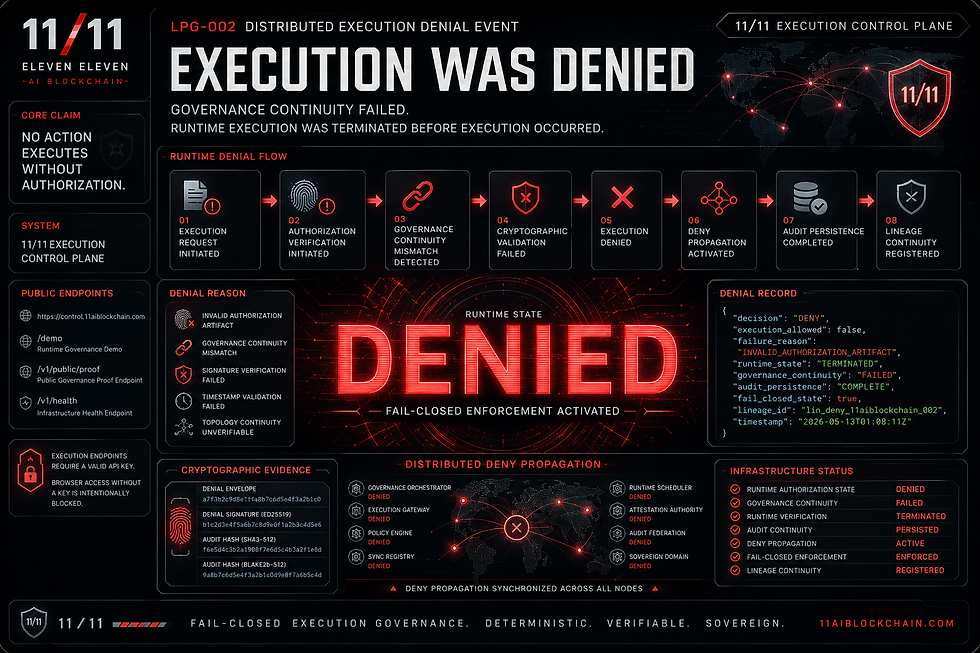
If authorization fails:execution fails closed.
No authorization:no execution.
Why Post-Execution Security Fails
Reactive security architectures operate too late.
Monitoring systems may identify:
anomalous behavior
policy deviation
suspicious runtime activity
integrity violations
But those detections occur after execution has already happened.
For autonomous systems:the damage window may only require milliseconds.
AI systems increasingly operate:
continuously
autonomously
across distributed infrastructure
at machine speed
Human response cycles cannot keep pace.
Pre-Execution Authorization Establishes Deterministic Control
Execution governance changes the operational model entirely.
Instead of:“execute first, inspect later”
the model becomes:“authorize before execution.”
This establishes:
deterministic runtime control
fail-closed enforcement
governed execution
cryptographic verification
immutable lineage
continuous runtime enforcement
Execution becomes:governed infrastructure.
Fail-Closed Enforcement
Execution governance assumes:
uncertainty defaults to deny
invalid authorization blocks execution
unauthorized runtime actions never proceed
governance must remain continuously enforceable
This creates:fail-closed infrastructure.
Fail-open systems are incompatible with autonomous execution environments.
AI Infrastructure Requires Runtime Governance
Autonomous systems increasingly require:
runtime authorization
continuous integrity verification
execution lineage
policy enforcement
cryptographic runtime trust
environment validation
Execution governance establishes:the runtime trust layer for AI infrastructure.
Execution Governance Architecture
Execution governance infrastructure typically includes:
Governance Control Plane
policy engine
authorization engine
risk analysis
integrity services
lineage services
Runtime Enforcement Layer
runtime guards
integrity monitors
behavioral enforcement
anomaly detection
fail-closed controls
Execution Infrastructure
compute
containers
orchestration
services
distributed runtime systems
Public Execution Governance Infrastructure
11/11 public execution governance infrastructure is operational:
Public Governance Console
Runtime Governance Demo
Public Governance Proof Viewer
Infrastructure Health Dashboard
Execution Lineage Explorer
Execution Governance vs Observability
Observability systems:
watch systems
collect telemetry
analyze after execution
Execution governance:
authorizes execution
enforces policy before runtime
verifies continuously
blocks unauthorized actions
maintains immutable lineage
Observability monitors systems.
Execution governance controls systems.
The Future Of AI Infrastructure
Autonomous compute systems increasingly require:
deterministic authorization
fail-closed execution
governed runtime infrastructure
continuous runtime enforcement
cryptographic runtime verification
immutable execution lineage
Execution governance becomes:foundational infrastructure for autonomous systems.
Conclusion
AI systems increasingly require:pre-execution governance.
Execution can no longer rely on:
inferred trust
delayed response
reactive monitoring
post-execution analysis
Execution must become:
authorized
governed
continuously verified
cryptographically provable
fail-closed by design
11/11 is building the execution governance layer for AI and regulated compute infrastructure.

Comments